Blog Posts Template

9 Best Medical Transcription Software Solutions Reviewed for 2026

This guide reviews nine of the best medical transcription software solutions available in 2026, evaluating each on AI accuracy, EHR integration, specialty support, and overall value. Whether you run a solo practice or a large multi-specialty health system, these breakdowns help you identify the right platform to reduce documentation burden and reclaim time for patient care.

Physicians and clinical staff spend a disproportionate share of their workday on documentation, time that could otherwise go toward patient care. Medical transcription software has evolved well beyond basic voice-to-text: today's solutions combine AI speech recognition, human quality review, and direct EHR integration to produce accurate, compliant clinical notes with minimal physician effort.

But not every platform delivers equally. Some excel at raw transcription speed; others prioritize accuracy through human oversight; still others are built specifically for surgical centers or multi-specialty hospitals. The options below cover nine of the strongest medical transcription software solutions available in 2026, evaluated on accuracy, EHR compatibility, workflow impact, specialty support, and overall value.

Whether you run a solo family practice, a busy cardiology group, or a large ambulatory surgery center, you'll find an option here that fits your environment. Use the breakdowns below to compare features and identify the right fit for your clinical setting.

1. ZyDoc

Best for: Specialty practices and health systems requiring expert-reviewed, EHR-ready clinical notes

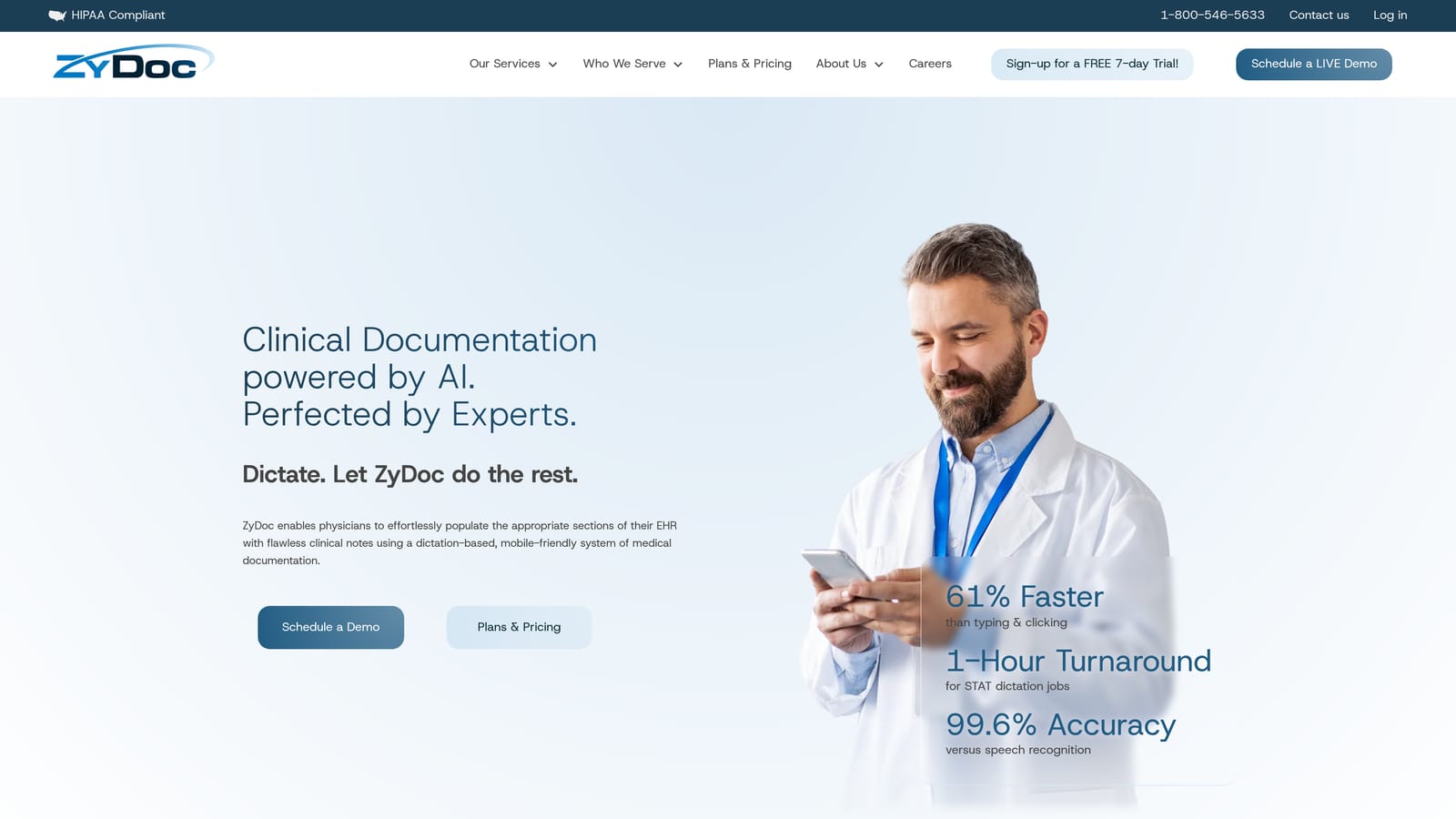
ZyDoc is an AI-powered clinical documentation platform that pairs speech recognition with credentialed human expert review to deliver accurate, EHR-ready notes across 20-plus specialties.

Screenshot of ZyDoc website

Where This Tool Shines

ZyDoc's core differentiator is its hybrid model: AI does the heavy lifting on transcription, but credentialed human experts review and refine every note before it reaches the EHR. That combination matters most in specialty settings where terminology is dense, documentation requirements are nuanced, and errors carry real clinical consequences.

Equally notable is the zero-workflow-change promise. Physicians dictate exactly as they always have; ZyDoc handles the rest, automatically populating notes into the EHR without requiring new habits, new interfaces, or new steps in the clinical day.

Key Features

AI Plus Human Review: Speech recognition is refined by credentialed experts, not AI alone, producing notes with a quality floor that pure-AI solutions cannot reliably match.

Universal EHR Integration: Automatically populates all major platforms including Epic, Cerner, Athenahealth, and eClinicalWorks, with no manual copy-paste required.

20-Plus Specialty Support: Specialty-specific documentation templates and language models cover cardiology, orthopedics, neurology, ambulatory surgery centers, and more.

Zero Workflow Disruption: Physicians dictate as they always have; no new interface to learn, no change to existing clinical routines.

HIPAA-Compliant Infrastructure: Robust security and compliance architecture designed specifically for protected health information.

Best For

ZyDoc is an excellent fit for specialty practices, multi-provider groups, and ambulatory surgery centers where documentation accuracy is non-negotiable and administrative bandwidth is limited. Solo practitioners who want expert-reviewed notes without managing a transcription team will also find strong value here.

Pricing

Contact ZyDoc directly for custom pricing based on practice size, specialty, and volume. A 7-day trial is available.

2. Nuance DAX Copilot

Best for: Health systems seeking ambient, hands-free clinical documentation integrated with Epic

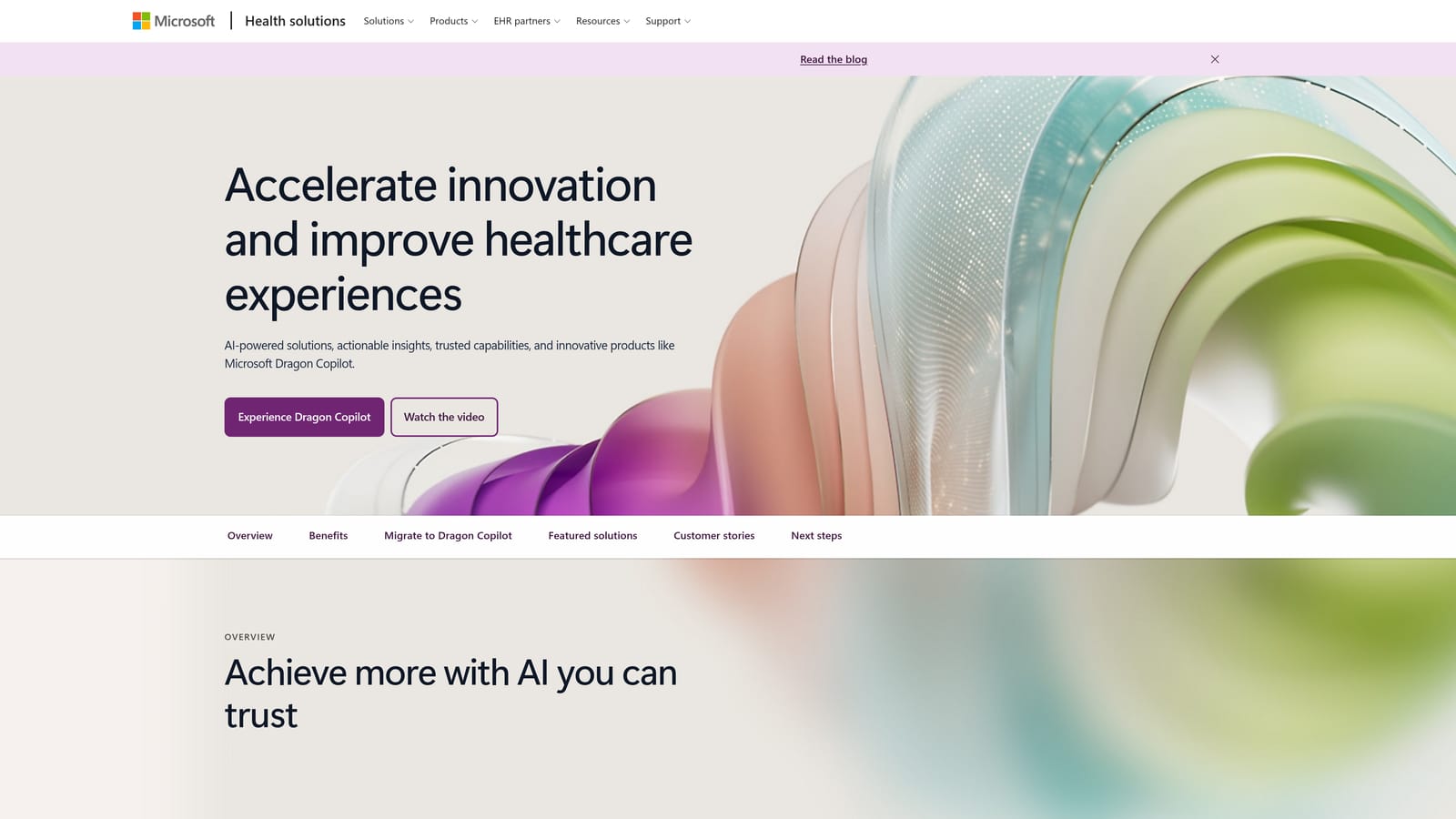
Nuance DAX Copilot is Microsoft's ambient clinical intelligence solution that listens passively during patient encounters and generates structured clinical notes without requiring active physician dictation.

Screenshot of Nuance DAX Copilot website

Where This Tool Shines

DAX Copilot's ambient listening model is its defining feature. There is no dictation trigger, no button to press, and no workflow step to remember. The physician conducts the visit naturally; the system captures the conversation and produces a structured note ready for review.

Backed by Microsoft's cloud and AI infrastructure, DAX Copilot benefits from significant enterprise-grade development resources. Its Epic integration is particularly deep, making it a natural consideration for Epic-centric health systems already operating within the Microsoft ecosystem.

Key Features

Ambient Listening: Passively captures patient encounters without requiring physician dictation or workflow triggers.

Structured Note Generation: Produces SOAP notes and specialty-specific documentation formats directly from encounter audio.

Epic Integration: Deep compatibility with Epic and other major EHR platforms.

Mobile Access: Available via mobile app for in-room use during patient encounters.

Microsoft AI Infrastructure: Leverages Microsoft's enterprise cloud and AI capabilities for scale and reliability.

Best For

Large health systems and hospital-affiliated practices already using Epic will find DAX Copilot a natural fit. It is particularly well-suited for physicians who want completely hands-free documentation and are comfortable with AI-generated notes requiring physician review before sign-off.

Pricing

Contact Nuance or Microsoft directly for pricing. DAX Copilot is typically offered as an enterprise subscription.

3. Suki AI

Best for: Physicians who want a voice assistant that learns their individual documentation style

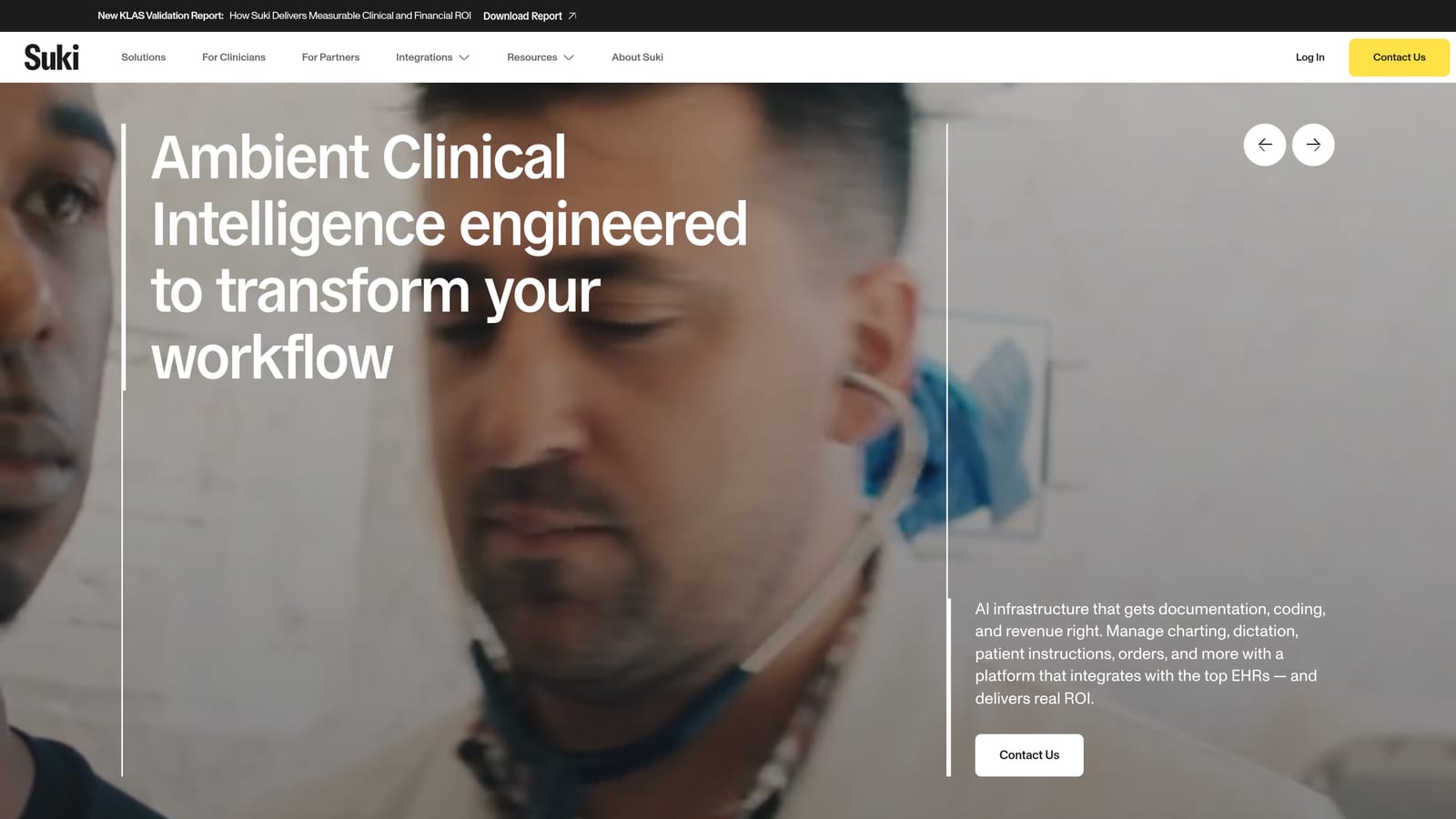
Suki AI is an AI voice assistant that works as a layer on top of existing EHR systems, allowing physicians to dictate note sections, add diagnoses, and complete documentation tasks using conversational voice commands.

Screenshot of Suki AI website

Where This Tool Shines

Suki's personalization engine sets it apart. The platform learns individual physician preferences over time, adapting to specific phrasing patterns, documentation habits, and specialty-specific terminology. The result is a system that feels increasingly tailored the longer a physician uses it.

The conversational command model also makes Suki accessible without a steep learning curve. Rather than dictating a full note in one pass, physicians can address individual sections, add diagnoses, or modify existing content using natural language, which reduces cognitive load during and after encounters.

Key Features

Conversational Commands: Physicians can dictate specific note sections, update problem lists, or add orders using natural language rather than full-note dictation.

Adaptive Learning: Suki learns individual physician preferences and documentation patterns over time.

Cross-Platform Access: Available on iOS, Android, and web for flexible use across clinical environments.

Specialty-Aware Language Models: Trained on specialty-specific clinical vocabulary for more accurate output.

Best For

Physicians in small to mid-size practices who want a voice assistant that adapts to their personal style. Also well-suited for providers who prefer incremental note-building over full-encounter dictation.

Pricing

Contact Suki for pricing. Suki operates on a per-provider subscription model.

4. Dolbey Fusion Narrate

Best for: Large health systems with dedicated HIM departments and complex workflow routing needs

Dolbey Fusion Narrate is an enterprise-grade clinical dictation and transcription platform built for large health systems, offering scalable workflow routing, transcription management, and deep EHR integration.

Screenshot of Dolbey Fusion Narrate website

Where This Tool Shines

Fusion Narrate is designed for environments where transcription is a managed, departmental function rather than an individual physician task. Health information management teams can route jobs, track quality, monitor turnaround times, and manage a pool of transcriptionists from a centralized dashboard.

The platform's support for both front-end (real-time) and back-end (transcriptionist-reviewed) workflows gives HIM departments flexibility to match the right workflow to the right documentation type, whether that is a quick outpatient note or a complex operative report.

Key Features

Scalable Workflow Routing: Routes dictation jobs across transcriptionists, editors, and quality reviewers based on configurable rules.

Dual Workflow Support: Handles both front-end real-time speech recognition and back-end transcriptionist-reviewed workflows.

EHR Integration: Integrates with Epic, Cerner, and other enterprise EHR platforms.

Quality Management Tools: Job tracking, QA dashboards, and productivity reporting for HIM supervisors.

Flexible Deployment: Available in both on-premise and cloud configurations.

Best For

Hospital HIM departments and large health systems managing high dictation volumes across multiple departments and transcriptionists. Not the right fit for small practices or solo providers.

Pricing

Contact Dolbey directly for enterprise pricing based on system size and deployment configuration.

5. MModal Fluency Direct

Best for: Clinicians who want real-time speech-to-text directly within their EHR interface

MModal Fluency Direct is a front-end speech recognition solution that allows clinicians to dictate directly into EHR fields in real time, populating structured data as they speak without a transcription queue.

Screenshot of MModal Fluency Direct website

Where This Tool Shines

Fluency Direct eliminates the transcription queue entirely. Physicians speak directly into EHR fields, and structured data populates in real time. There is no waiting period, no separate application to switch to, and no intermediate file to manage. For practices where speed is the primary priority, this model is hard to beat.

The platform's specialty-trained clinical language models reduce the friction that comes with general-purpose speech recognition encountering complex medical terminology. Custom vocabulary support further adapts the system to individual physician speech patterns over time.

Key Features

Real-Time EHR Population: Dictation populates directly into EHR fields as the physician speaks, with no transcription delay.

In-EHR Operation: Works within the existing EHR interface without requiring application switching.

Specialty Language Models: Trained on clinical terminology across multiple specialties for improved recognition accuracy.

Custom Vocabulary: Supports physician-specific vocabulary and adaptation over time.

Broad EHR Compatibility: Available for major EHR platforms across health system environments.

Best For

Clinicians and practices that prioritize immediate note completion and are willing to self-edit AI-generated content. Well-suited for high-volume outpatient settings where speed and EHR-native operation are the primary requirements.

Pricing

Contact MModal (now part of 3M Health Information Systems) for pricing information.

6. Nvoq

Best for: Practices and regional health systems modernizing away from legacy on-premise dictation infrastructure

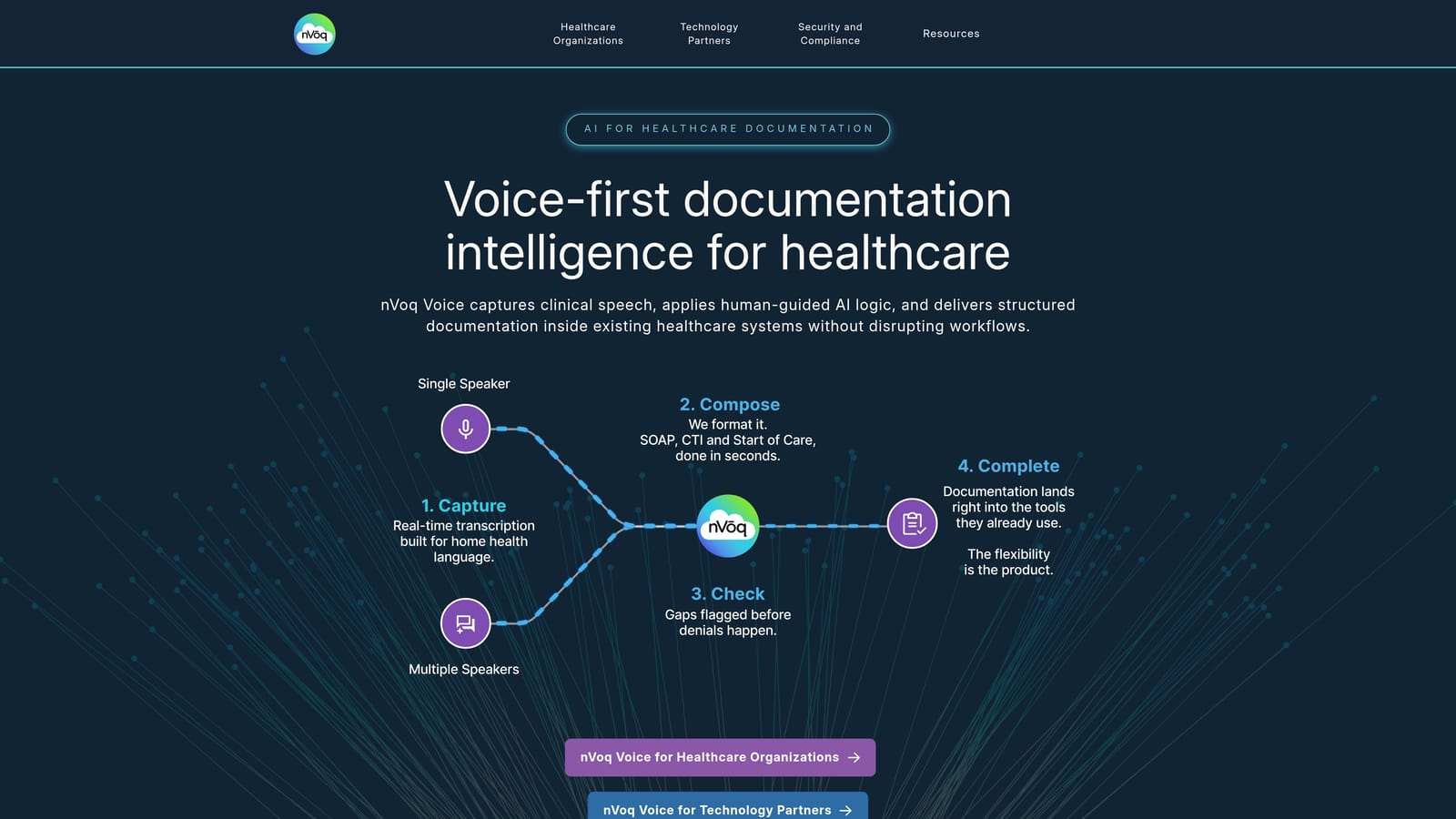
Nvoq is a cloud-native speech recognition platform for healthcare with specialty-trained language models, designed for organizations ready to move beyond aging on-premise dictation systems.

Screenshot of Nvoq website

Where This Tool Shines

Nvoq's cloud-first architecture is its clearest advantage for organizations still running legacy on-premise dictation hardware. There is no server infrastructure to maintain, no on-site IT burden, and no hardware refresh cycle to plan around. Deployment is faster and ongoing maintenance is significantly lighter than traditional systems.

Specialty-specific language model training means Nvoq is not simply applying general speech recognition to clinical content. The models are built to understand clinical vocabulary, which matters when documentation accuracy affects coding, compliance, and patient care continuity.

Key Features

Cloud-First Architecture: Fully cloud-native with no on-premise server requirements or hardware dependencies.

Specialty Language Models: Trained on specialty-specific clinical vocabulary for more accurate transcription output.

EHR and Practice Management Integration: Connects with EHR and practice management systems for streamlined documentation workflows.

Flexible Input Options: Supports microphone, headset, and mobile device input across clinical environments.

HIPAA-Compliant Infrastructure: Cloud environment built to meet healthcare data security and compliance requirements.

Best For

Regional health systems, multi-site practices, and organizations actively replacing legacy dictation infrastructure. Particularly well-suited for IT teams that want to reduce on-premise complexity without sacrificing clinical language accuracy.

Pricing

Contact Nvoq for pricing. Nvoq operates on a subscription-based model.

7. TranscribeMe

Best for: Practices requiring high-accuracy human transcription for complex or jargon-heavy clinical dictations

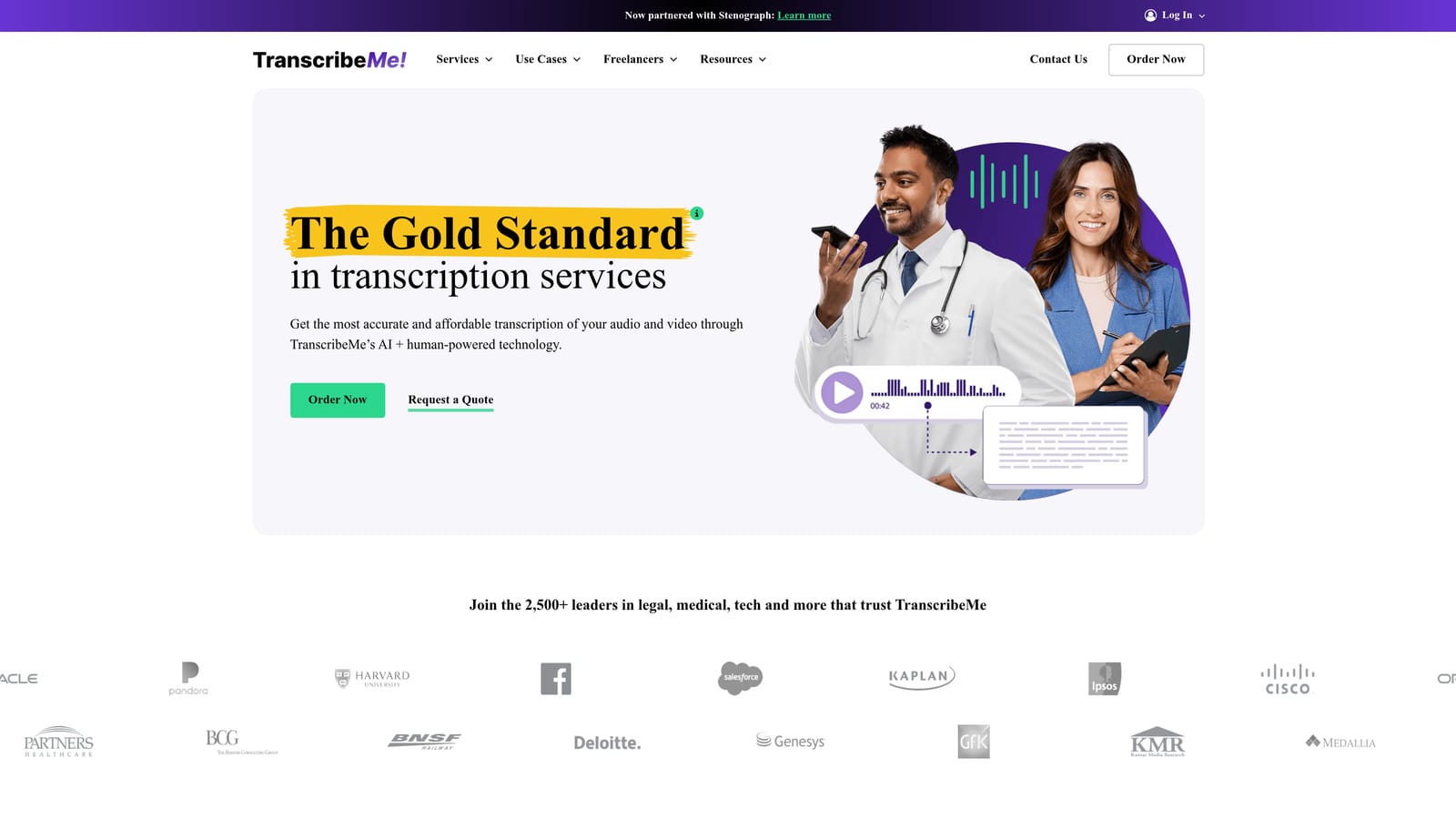
TranscribeMe is a human-powered transcription service with a dedicated medical transcription offering, staffed by credentialed transcriptionists who specialize in clinical terminology and complex dictations.

Screenshot of TranscribeMe website

Where This Tool Shines

TranscribeMe's medical transcription service leans on human expertise rather than AI automation. For dictations that are heavily accented, terminology-dense, or structurally complex, credentialed human transcriptionists can handle nuance that automated systems sometimes miss.

The audio file upload model is also device-agnostic. Physicians can record on any device they prefer and submit files for transcription without being locked into a specific application or hardware ecosystem. Turnaround options range from standard to expedited depending on urgency.

Key Features

Credentialed Human Transcriptionists: Medical specialists with training in clinical terminology handle dictations rather than automated AI systems.

Device-Agnostic Submission: Supports audio file upload from any recording device, with no proprietary hardware required.

HIPAA-Compliant Handling: Secure file handling and data security protocols designed for protected health information.

Turnaround Flexibility: Standard and expedited turnaround options to match urgency requirements.

Complex Dictation Capability: Well-suited for accented speech, dense clinical jargon, or non-standard documentation formats.

Best For

Practices with complex or specialty-specific dictations that have challenged automated systems, or providers who prefer human review over AI-generated output. Also useful as a supplemental service for overflow or specialty documentation needs.

Pricing

Medical transcription pricing is available on request. General transcription rates are published on the TranscribeMe website; medical pricing may differ based on complexity and volume.

8. Crescendo Systems

Best for: Hospital HIM departments managing high-volume transcription workflows across multiple transcriptionists

Crescendo Systems is a transcription workflow management platform built for health information management departments, providing job routing, quality tracking, and transcriptionist productivity tools for high-volume hospital environments.

Where This Tool Shines

Crescendo is not a transcription service; it is a workflow management layer for organizations that already have transcriptionists and need better tools to manage them. The platform handles job routing, queue management, supervisor review, and productivity reporting, giving HIM managers visibility into the entire transcription operation.

For hospitals processing large volumes of dictation across multiple document types and departments, the ability to track turnaround times, identify bottlenecks, and manage quality at scale is genuinely valuable. Crescendo is purpose-built for that operational context.

Key Features

Workflow Routing and Queue Management: Routes transcription jobs across staff based on configurable rules and priority settings.

Quality Assurance Dashboards: Supervisor review tools and QA tracking for maintaining documentation standards at scale.

Multi-Transcriptionist Support: Designed for teams with multiple transcriptionists and layered review workflows.

EHR and Dictation System Integration: Connects with hospital EHR and dictation platforms for end-to-end workflow continuity.

Productivity and Turnaround Reporting: Analytics tools for monitoring output, turnaround time, and individual transcriptionist performance.

Best For

Hospital HIM departments and large health systems with in-house transcription teams that need better workflow management, quality oversight, and productivity visibility. Not designed for small practices or individual providers.

Pricing

Contact Crescendo Systems directly for enterprise pricing.

9. Otter.ai

Best for: Healthcare administrators needing transcription for meetings, care coordination calls, and non-clinical workflows

Otter.ai is a general-purpose AI transcription tool used in healthcare settings primarily for administrative meetings, care coordination calls, and non-clinical documentation. It is not purpose-built for clinical note generation.

Where This Tool Shines

Otter.ai earns a place on this list not as a clinical documentation tool, but as a genuinely useful administrative one. For team meetings, care coordination calls, training sessions, and operational discussions, its real-time transcription, speaker identification, and collaborative editing features work well and are priced accessibly.

The integrations with Zoom, Google Meet, and Microsoft Teams make it easy to capture and search meeting content without any additional setup. For healthcare organizations looking to reduce administrative note-taking burden outside the clinical encounter, Otter.ai is a practical and affordable option.

Key Features

Real-Time AI Transcription: Captures and transcribes spoken content in real time with speaker identification.

Collaborative Editing: Team members can highlight, comment, and edit shared transcripts together.

Meeting Platform Integrations: Connects with Zoom, Google Meet, and Microsoft Teams for automatic meeting capture.

Accessible Pricing: Free tier available, with affordable paid plans for individuals and teams.

Mobile and Web Access: Available across devices for flexible use in administrative contexts.

Best For

Healthcare administrators, practice managers, and clinical educators who need transcription for non-clinical workflows. Otter.ai is not appropriate for clinical note generation, patient encounter documentation, or any workflow requiring HIPAA-grade compliance assurance for protected health information.

Pricing

A free tier is available. The Pro plan starts at approximately $10 per user per month, with Business plans available for teams. Pricing is published on the Otter.ai website.

Which Tool Is Right for Your Practice?

The right medical transcription software depends on three variables above all others: accuracy requirements, EHR compatibility, and how much workflow disruption your team can absorb. Get those three right, and everything else falls into place.

For solo and small practices, the priority is usually simplicity and accuracy without adding administrative overhead. ZyDoc stands out here because the AI-plus-human-review model delivers expert-quality notes without requiring a dedicated transcription team or any change to how physicians already dictate. Suki AI is another strong option for providers who want a voice assistant that adapts to their personal documentation style over time.

For multi-specialty groups and mid-size organizations, ZyDoc's support for 20-plus specialties and universal EHR integration makes it a scalable choice across departments. Nuance DAX Copilot is worth serious consideration for Epic-centric organizations that want fully ambient, hands-free documentation at the encounter level.

For hospitals, health systems, and ambulatory surgery centers managing high documentation volumes, Dolbey Fusion Narrate and Crescendo Systems address the operational complexity of HIM-managed transcription workflows. For organizations modernizing away from legacy infrastructure, Nvoq's cloud-native architecture reduces IT burden considerably.

If your priority is expert-reviewed, EHR-ready clinical notes delivered without changing a single step in your current workflow, ZyDoc is built exactly for that. Clear your backlog, sign finished notes and encounter summaries today, and get real humans in the loop alongside AI. Start your 7-day trial today or contact us to set up a demo for your team and receive 30 days of our full STAT service on us!

Heading 1

Heading 2

Heading 3

Heading 4

Heading 5
Heading 6

Lorem ipsum dolor sit amet, consectetur adipiscing elit, sed do eiusmod tempor incididunt ut labore et dolore magna aliqua. Ut enim ad minim veniam, quis nostrud exercitation ullamco laboris nisi ut aliquip ex ea commodo consequat. Duis aute irure dolor in reprehenderit in voluptate velit esse cillum dolore eu fugiat nulla pariatur.

Block quote

Ordered list

  1. Item 1
  2. Item 2
  3. Item 3

Unordered list

  • Item A
  • Item B
  • Item C

Text link

Bold text

Emphasis

Superscript

Subscript

Heading 1

Heading 2

Heading 3

Heading 4

Heading 5
Heading 6

Lorem ipsum dolor sit amet, consectetur adipiscing elit, sed do eiusmod tempor incididunt ut labore et dolore magna aliqua. Ut enim ad minim veniam, quis nostrud exercitation ullamco laboris nisi ut aliquip ex ea commodo consequat. Duis aute irure dolor in reprehenderit in voluptate velit esse cillum dolore eu fugiat nulla pariatur.

Block quote

Ordered list

  1. Item 1
  2. Item 2
  3. Item 3

Unordered list

  • Item A
  • Item B
  • Item C

Text link

Bold text

Emphasis

Superscript

Subscript

Trusted and Tested

Why Doctors Choose ZyDoc Medical Transcription.

Hospitals

ZyDoc has offered a productive solution that allows our Patient Care Providers to maintain prompt patient care, efficient patient documentation turnaround, and a preferred convenience with the use of smart phone app for dictation. With the integrated interface into our EMR, completed patient visit notes are available promptly for continued patient care and sharing of information. Additionally, the response time for support and application assistance is excellent, knowledgeable and friendly.

Michelle MacDonald
Copley Hospital
Orthopedic

"The doctors like the mobile app and they find it easy to use!"

Sandy Wagner
Arlington Orthopedics
Orthopedic

"Professional service, fast turnaround, very efficient and excellent value for money!"

Milan Oleksak, M.D.
Orthopaedic & Physiotherapy Associates
Orthopedic

“I have never dealt with an easier transcription service. Rapid turnaround time for dictations and an easy to contact customer service.”

Jennifer Biddle
Advanced Physician Services, PC
ASCs

“It has been really easy to get ZyDoc up and running at our new multi-specialty center. The team at Zydoc has been top quality and easy to work with and the physicians are finding the service very easy to use.

Amy Cooper - CEO
Green Mountain Surgery Center
Mental Health

“Accuracy: The level of accuracy is exceptional and exceeds the expected accuracy standards! Customer service: Consistently amazing customer service. Never too busy and always makes you feel important. Communication: Working with ZyDoc to integrate our myAvatar EHR system and the committed communication is the key to our success. Thank you for all you do for us and thanks for always caring!”

Nevada Department of Health and Human Services
Division of Child and Family Services

Stop Wasting Time in Your EHR.

Say it once. Get it done.

With ZyDoc’s mobile-friendly documentation, you can skip the endless typing and clicking. Just select your patient, choose the note type, and dictate. We’ll handle the rest with flawless EHR insertion.

Comparison

9 Best Medical Transcription Software Solutions Reviewed for 2026

Physicians and clinical staff spend a disproportionate share of their workday on documentation, time that could otherwise go toward patient care. Medical transcription software has evolved well beyond basic voice-to-text: today's solutions combine AI speech recognition, human quality review, and direct EHR integration to produce accurate, compliant clinical notes with minimal physician effort.

But not every platform delivers equally. Some excel at raw transcription speed; others prioritize accuracy through human oversight; still others are built specifically for surgical centers or multi-specialty hospitals. The options below cover nine of the strongest medical transcription software solutions available in 2026, evaluated on accuracy, EHR compatibility, workflow impact, specialty support, and overall value.

Whether you run a solo family practice, a busy cardiology group, or a large ambulatory surgery center, you'll find an option here that fits your environment. Use the breakdowns below to compare features and identify the right fit for your clinical setting.

1. ZyDoc

Best for: Specialty practices and health systems requiring expert-reviewed, EHR-ready clinical notes

ZyDoc is an AI-powered clinical documentation platform that pairs speech recognition with credentialed human expert review to deliver accurate, EHR-ready notes across 20-plus specialties.

Screenshot of ZyDoc website

Where This Tool Shines

ZyDoc's core differentiator is its hybrid model: AI does the heavy lifting on transcription, but credentialed human experts review and refine every note before it reaches the EHR. That combination matters most in specialty settings where terminology is dense, documentation requirements are nuanced, and errors carry real clinical consequences.

Equally notable is the zero-workflow-change promise. Physicians dictate exactly as they always have; ZyDoc handles the rest, automatically populating notes into the EHR without requiring new habits, new interfaces, or new steps in the clinical day.

Key Features

AI Plus Human Review: Speech recognition is refined by credentialed experts, not AI alone, producing notes with a quality floor that pure-AI solutions cannot reliably match.

Universal EHR Integration: Automatically populates all major platforms including Epic, Cerner, Athenahealth, and eClinicalWorks, with no manual copy-paste required.

20-Plus Specialty Support: Specialty-specific documentation templates and language models cover cardiology, orthopedics, neurology, ambulatory surgery centers, and more.

Zero Workflow Disruption: Physicians dictate as they always have; no new interface to learn, no change to existing clinical routines.

HIPAA-Compliant Infrastructure: Robust security and compliance architecture designed specifically for protected health information.

Best For

ZyDoc is an excellent fit for specialty practices, multi-provider groups, and ambulatory surgery centers where documentation accuracy is non-negotiable and administrative bandwidth is limited. Solo practitioners who want expert-reviewed notes without managing a transcription team will also find strong value here.

Pricing

Contact ZyDoc directly for custom pricing based on practice size, specialty, and volume. A 7-day trial is available.

2. Nuance DAX Copilot

Best for: Health systems seeking ambient, hands-free clinical documentation integrated with Epic

Nuance DAX Copilot is Microsoft's ambient clinical intelligence solution that listens passively during patient encounters and generates structured clinical notes without requiring active physician dictation.

Screenshot of Nuance DAX Copilot website

Where This Tool Shines

DAX Copilot's ambient listening model is its defining feature. There is no dictation trigger, no button to press, and no workflow step to remember. The physician conducts the visit naturally; the system captures the conversation and produces a structured note ready for review.

Backed by Microsoft's cloud and AI infrastructure, DAX Copilot benefits from significant enterprise-grade development resources. Its Epic integration is particularly deep, making it a natural consideration for Epic-centric health systems already operating within the Microsoft ecosystem.

Key Features

Ambient Listening: Passively captures patient encounters without requiring physician dictation or workflow triggers.

Structured Note Generation: Produces SOAP notes and specialty-specific documentation formats directly from encounter audio.

Epic Integration: Deep compatibility with Epic and other major EHR platforms.

Mobile Access: Available via mobile app for in-room use during patient encounters.

Microsoft AI Infrastructure: Leverages Microsoft's enterprise cloud and AI capabilities for scale and reliability.

Best For

Large health systems and hospital-affiliated practices already using Epic will find DAX Copilot a natural fit. It is particularly well-suited for physicians who want completely hands-free documentation and are comfortable with AI-generated notes requiring physician review before sign-off.

Pricing

Contact Nuance or Microsoft directly for pricing. DAX Copilot is typically offered as an enterprise subscription.

3. Suki AI

Best for: Physicians who want a voice assistant that learns their individual documentation style

Suki AI is an AI voice assistant that works as a layer on top of existing EHR systems, allowing physicians to dictate note sections, add diagnoses, and complete documentation tasks using conversational voice commands.

Screenshot of Suki AI website

Where This Tool Shines

Suki's personalization engine sets it apart. The platform learns individual physician preferences over time, adapting to specific phrasing patterns, documentation habits, and specialty-specific terminology. The result is a system that feels increasingly tailored the longer a physician uses it.

The conversational command model also makes Suki accessible without a steep learning curve. Rather than dictating a full note in one pass, physicians can address individual sections, add diagnoses, or modify existing content using natural language, which reduces cognitive load during and after encounters.

Key Features

Conversational Commands: Physicians can dictate specific note sections, update problem lists, or add orders using natural language rather than full-note dictation.

Adaptive Learning: Suki learns individual physician preferences and documentation patterns over time.

Cross-Platform Access: Available on iOS, Android, and web for flexible use across clinical environments.

Specialty-Aware Language Models: Trained on specialty-specific clinical vocabulary for more accurate output.

Best For

Physicians in small to mid-size practices who want a voice assistant that adapts to their personal style. Also well-suited for providers who prefer incremental note-building over full-encounter dictation.

Pricing

Contact Suki for pricing. Suki operates on a per-provider subscription model.

4. Dolbey Fusion Narrate

Best for: Large health systems with dedicated HIM departments and complex workflow routing needs

Dolbey Fusion Narrate is an enterprise-grade clinical dictation and transcription platform built for large health systems, offering scalable workflow routing, transcription management, and deep EHR integration.

Screenshot of Dolbey Fusion Narrate website

Where This Tool Shines

Fusion Narrate is designed for environments where transcription is a managed, departmental function rather than an individual physician task. Health information management teams can route jobs, track quality, monitor turnaround times, and manage a pool of transcriptionists from a centralized dashboard.

The platform's support for both front-end (real-time) and back-end (transcriptionist-reviewed) workflows gives HIM departments flexibility to match the right workflow to the right documentation type, whether that is a quick outpatient note or a complex operative report.

Key Features

Scalable Workflow Routing: Routes dictation jobs across transcriptionists, editors, and quality reviewers based on configurable rules.

Dual Workflow Support: Handles both front-end real-time speech recognition and back-end transcriptionist-reviewed workflows.

EHR Integration: Integrates with Epic, Cerner, and other enterprise EHR platforms.

Quality Management Tools: Job tracking, QA dashboards, and productivity reporting for HIM supervisors.

Flexible Deployment: Available in both on-premise and cloud configurations.

Best For

Hospital HIM departments and large health systems managing high dictation volumes across multiple departments and transcriptionists. Not the right fit for small practices or solo providers.

Pricing

Contact Dolbey directly for enterprise pricing based on system size and deployment configuration.

5. MModal Fluency Direct

Best for: Clinicians who want real-time speech-to-text directly within their EHR interface

MModal Fluency Direct is a front-end speech recognition solution that allows clinicians to dictate directly into EHR fields in real time, populating structured data as they speak without a transcription queue.

Screenshot of MModal Fluency Direct website

Where This Tool Shines

Fluency Direct eliminates the transcription queue entirely. Physicians speak directly into EHR fields, and structured data populates in real time. There is no waiting period, no separate application to switch to, and no intermediate file to manage. For practices where speed is the primary priority, this model is hard to beat.

The platform's specialty-trained clinical language models reduce the friction that comes with general-purpose speech recognition encountering complex medical terminology. Custom vocabulary support further adapts the system to individual physician speech patterns over time.

Key Features

Real-Time EHR Population: Dictation populates directly into EHR fields as the physician speaks, with no transcription delay.

In-EHR Operation: Works within the existing EHR interface without requiring application switching.

Specialty Language Models: Trained on clinical terminology across multiple specialties for improved recognition accuracy.

Custom Vocabulary: Supports physician-specific vocabulary and adaptation over time.

Broad EHR Compatibility: Available for major EHR platforms across health system environments.

Best For

Clinicians and practices that prioritize immediate note completion and are willing to self-edit AI-generated content. Well-suited for high-volume outpatient settings where speed and EHR-native operation are the primary requirements.

Pricing

Contact MModal (now part of 3M Health Information Systems) for pricing information.

6. Nvoq

Best for: Practices and regional health systems modernizing away from legacy on-premise dictation infrastructure

Nvoq is a cloud-native speech recognition platform for healthcare with specialty-trained language models, designed for organizations ready to move beyond aging on-premise dictation systems.

Screenshot of Nvoq website

Where This Tool Shines

Nvoq's cloud-first architecture is its clearest advantage for organizations still running legacy on-premise dictation hardware. There is no server infrastructure to maintain, no on-site IT burden, and no hardware refresh cycle to plan around. Deployment is faster and ongoing maintenance is significantly lighter than traditional systems.

Specialty-specific language model training means Nvoq is not simply applying general speech recognition to clinical content. The models are built to understand clinical vocabulary, which matters when documentation accuracy affects coding, compliance, and patient care continuity.

Key Features

Cloud-First Architecture: Fully cloud-native with no on-premise server requirements or hardware dependencies.

Specialty Language Models: Trained on specialty-specific clinical vocabulary for more accurate transcription output.

EHR and Practice Management Integration: Connects with EHR and practice management systems for streamlined documentation workflows.

Flexible Input Options: Supports microphone, headset, and mobile device input across clinical environments.

HIPAA-Compliant Infrastructure: Cloud environment built to meet healthcare data security and compliance requirements.

Best For

Regional health systems, multi-site practices, and organizations actively replacing legacy dictation infrastructure. Particularly well-suited for IT teams that want to reduce on-premise complexity without sacrificing clinical language accuracy.

Pricing

Contact Nvoq for pricing. Nvoq operates on a subscription-based model.

7. TranscribeMe

Best for: Practices requiring high-accuracy human transcription for complex or jargon-heavy clinical dictations

TranscribeMe is a human-powered transcription service with a dedicated medical transcription offering, staffed by credentialed transcriptionists who specialize in clinical terminology and complex dictations.

Screenshot of TranscribeMe website

Where This Tool Shines

TranscribeMe's medical transcription service leans on human expertise rather than AI automation. For dictations that are heavily accented, terminology-dense, or structurally complex, credentialed human transcriptionists can handle nuance that automated systems sometimes miss.

The audio file upload model is also device-agnostic. Physicians can record on any device they prefer and submit files for transcription without being locked into a specific application or hardware ecosystem. Turnaround options range from standard to expedited depending on urgency.

Key Features

Credentialed Human Transcriptionists: Medical specialists with training in clinical terminology handle dictations rather than automated AI systems.

Device-Agnostic Submission: Supports audio file upload from any recording device, with no proprietary hardware required.

HIPAA-Compliant Handling: Secure file handling and data security protocols designed for protected health information.

Turnaround Flexibility: Standard and expedited turnaround options to match urgency requirements.

Complex Dictation Capability: Well-suited for accented speech, dense clinical jargon, or non-standard documentation formats.

Best For

Practices with complex or specialty-specific dictations that have challenged automated systems, or providers who prefer human review over AI-generated output. Also useful as a supplemental service for overflow or specialty documentation needs.

Pricing

Medical transcription pricing is available on request. General transcription rates are published on the TranscribeMe website; medical pricing may differ based on complexity and volume.

8. Crescendo Systems

Best for: Hospital HIM departments managing high-volume transcription workflows across multiple transcriptionists

Crescendo Systems is a transcription workflow management platform built for health information management departments, providing job routing, quality tracking, and transcriptionist productivity tools for high-volume hospital environments.

Where This Tool Shines

Crescendo is not a transcription service; it is a workflow management layer for organizations that already have transcriptionists and need better tools to manage them. The platform handles job routing, queue management, supervisor review, and productivity reporting, giving HIM managers visibility into the entire transcription operation.

For hospitals processing large volumes of dictation across multiple document types and departments, the ability to track turnaround times, identify bottlenecks, and manage quality at scale is genuinely valuable. Crescendo is purpose-built for that operational context.

Key Features

Workflow Routing and Queue Management: Routes transcription jobs across staff based on configurable rules and priority settings.

Quality Assurance Dashboards: Supervisor review tools and QA tracking for maintaining documentation standards at scale.

Multi-Transcriptionist Support: Designed for teams with multiple transcriptionists and layered review workflows.

EHR and Dictation System Integration: Connects with hospital EHR and dictation platforms for end-to-end workflow continuity.

Productivity and Turnaround Reporting: Analytics tools for monitoring output, turnaround time, and individual transcriptionist performance.

Best For

Hospital HIM departments and large health systems with in-house transcription teams that need better workflow management, quality oversight, and productivity visibility. Not designed for small practices or individual providers.

Pricing

Contact Crescendo Systems directly for enterprise pricing.

9. Otter.ai

Best for: Healthcare administrators needing transcription for meetings, care coordination calls, and non-clinical workflows

Otter.ai is a general-purpose AI transcription tool used in healthcare settings primarily for administrative meetings, care coordination calls, and non-clinical documentation. It is not purpose-built for clinical note generation.

Where This Tool Shines

Otter.ai earns a place on this list not as a clinical documentation tool, but as a genuinely useful administrative one. For team meetings, care coordination calls, training sessions, and operational discussions, its real-time transcription, speaker identification, and collaborative editing features work well and are priced accessibly.

The integrations with Zoom, Google Meet, and Microsoft Teams make it easy to capture and search meeting content without any additional setup. For healthcare organizations looking to reduce administrative note-taking burden outside the clinical encounter, Otter.ai is a practical and affordable option.

Key Features

Real-Time AI Transcription: Captures and transcribes spoken content in real time with speaker identification.

Collaborative Editing: Team members can highlight, comment, and edit shared transcripts together.

Meeting Platform Integrations: Connects with Zoom, Google Meet, and Microsoft Teams for automatic meeting capture.

Accessible Pricing: Free tier available, with affordable paid plans for individuals and teams.

Mobile and Web Access: Available across devices for flexible use in administrative contexts.

Best For

Healthcare administrators, practice managers, and clinical educators who need transcription for non-clinical workflows. Otter.ai is not appropriate for clinical note generation, patient encounter documentation, or any workflow requiring HIPAA-grade compliance assurance for protected health information.

Pricing

A free tier is available. The Pro plan starts at approximately $10 per user per month, with Business plans available for teams. Pricing is published on the Otter.ai website.

Which Tool Is Right for Your Practice?

The right medical transcription software depends on three variables above all others: accuracy requirements, EHR compatibility, and how much workflow disruption your team can absorb. Get those three right, and everything else falls into place.

For solo and small practices, the priority is usually simplicity and accuracy without adding administrative overhead. ZyDoc stands out here because the AI-plus-human-review model delivers expert-quality notes without requiring a dedicated transcription team or any change to how physicians already dictate. Suki AI is another strong option for providers who want a voice assistant that adapts to their personal documentation style over time.

For multi-specialty groups and mid-size organizations, ZyDoc's support for 20-plus specialties and universal EHR integration makes it a scalable choice across departments. Nuance DAX Copilot is worth serious consideration for Epic-centric organizations that want fully ambient, hands-free documentation at the encounter level.

For hospitals, health systems, and ambulatory surgery centers managing high documentation volumes, Dolbey Fusion Narrate and Crescendo Systems address the operational complexity of HIM-managed transcription workflows. For organizations modernizing away from legacy infrastructure, Nvoq's cloud-native architecture reduces IT burden considerably.

If your priority is expert-reviewed, EHR-ready clinical notes delivered without changing a single step in your current workflow, ZyDoc is built exactly for that. Clear your backlog, sign finished notes and encounter summaries today, and get real humans in the loop alongside AI. Start your 7-day trial today or contact us to set up a demo for your team and receive 30 days of our full STAT service on us!
Frequently Asked Questions

Does ZyDoc require workflow changes?

ZyDoc requires no workflow changes for clinicians that are used to dictating.  with telephones just like the hospital systems or digital recorders with 1 click or drag-and-drop upload.  Or smart phone, tablet or browser. on your computer with the microphone make the process easier from your schedule feed to select the patient so you do not have to dictate or keypad demographic patient information.  The finished, expert-reviewed note is inserted directly into the correct EHR sections — no copy-and-paste, no software installation, and minimal training ("minutes to train, not weeks"). The result is the same charting workflow clinicians know, just faster and without the typing-and-clicking burden.

Does ZyDoc support specialty workflows?

Yes. ZyDoc uses proprietary, specialty-specific language models and supports physicians across roughly 20 disciplines, including Anesthesiology, Cardiology, Chiropractic, Dermatology, Endocrinology, Family Practice, Gastroenterology, General Medicine, General Surgery, Genetics, Gynecology, Hematology-Oncology, Independent Medical Examiners, Internal Medicine, Mental Health, Nephrology, Neurology, Ophthalmology, Orthopedics, Radiology and Urology. Each specialty is supported across its major procedures and note types (e.g., op reports, consults, follow-ups, IME reports with e-signature, SOAP notes), and customers can configure job-type templates, default normals, and frequently-used phrase insertions to match how their specialty documents. We integrate with the leaading EHRs of these specialists.

Ready to see ZyDoc in action?

Pricing Plans

Plans from $125/mo.
$0 for 30 days after booking a Demo.

ROI Calculator

See the real financial impact of switching to ZyDoc and estimate how much more revenue you could generate.

Book a Live Demo

Get a personalized walkthrough of how ZyDoc can improve documentation, efficiency, and revenue.

About ZyDoc Clinical IntelligenceTM

Since 1993, ZyDoc has worked alongside physicians, healthcare organizations, researchers, and technology innovators to solve some of healthcare's most complex operational and clinical challenges. Through decades of collaboration with academic institutions, provider organizations, and industryleaders, we've learned that meaningful innovation begins by listening to the people delivering care.

We publish evidence-based research, expert analysis, implementation guidance, and thought leadership designed to help clinicians, executives, administrators, and healthcare innovators make better decisions.

Our commitment to digital health innovation: translate complexity into clarity, ground every insight in evidence, and ensure that the clinical voice remains central to healthcare innovation with the intelligence of business.