Blog Posts Template

9 Best Voice to Text Medical Software Tools in 2026

Voice to text medical software helps clinicians escape documentation overload by transcribing, formatting, and entering notes into EHRs automatically — freeing more time for direct patient care. This guide evaluates the 9 best solutions available in 2026 across accuracy, EHR integration, specialty support, and workflow fit for practices of every size.

Physicians routinely spend a substantial portion of their workday on documentation rather than direct patient care. That imbalance is exactly what voice to text medical software is designed to fix, giving clinicians the freedom to speak naturally while software handles transcription, formatting, and EHR entry.

But the category has grown considerably, and not every solution works the same way. Some tools rely entirely on AI. Others combine AI with human review. Some listen passively during encounters; others require active dictation. And a handful are purpose-built for specific care settings or specialties.

This guide covers the top voice to text medical software tools available in 2026, evaluated on accuracy, EHR integration, specialty support, workflow fit, and overall value. Whether you run a solo practice, lead a specialty group, manage a hospital system, or operate an ambulatory surgery center, there is a solution here worth your attention. ZyDoc appears first because it is the platform behind this content, but every tool on this list has been selected for genuine merit.

1. ZyDoc

Best for: Physicians and practices that want AI-powered transcription verified by human medical editors, with seamless EHR integration across all major platforms.

ZyDoc is an AI-powered clinical documentation and transcription platform that pairs speech recognition with human medical editor review, automatically populating finished notes into your EHR without requiring any workflow changes.

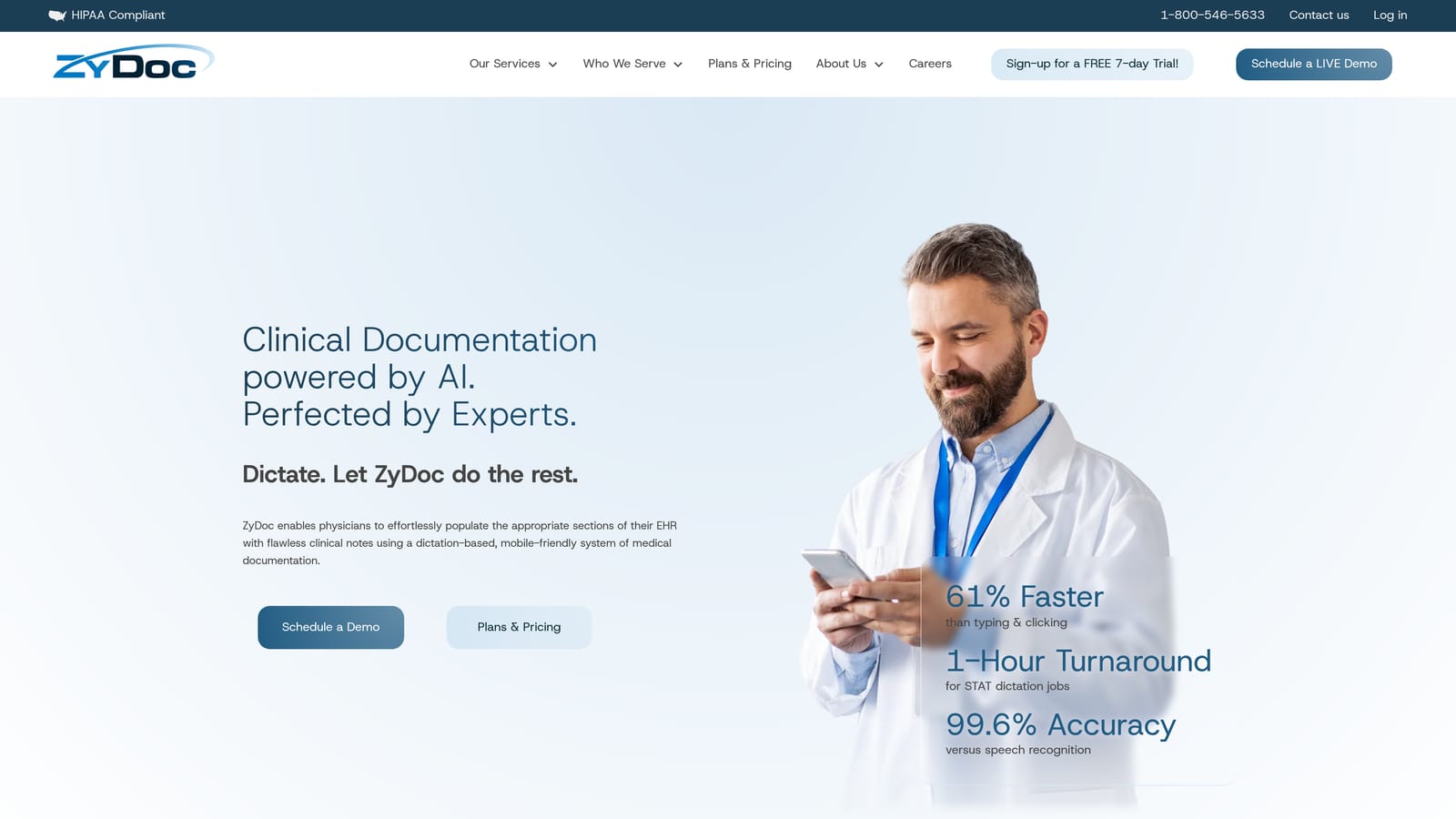
Screenshot of ZyDoc website

Where This Tool Shines

ZyDoc occupies a distinct position in the market: it does not ask you to choose between AI speed and human accuracy. Every note generated by the AI engine is reviewed and corrected by a trained medical editor before it lands in your EHR. That layer of human oversight is particularly valuable for complex specialty documentation where nuance matters and errors carry real consequences.

The platform is also genuinely flexible on the input side. Physicians can dictate via smartphone app, traditional handheld recorder, or telephone, fitting naturally into existing habits rather than demanding new ones. That flexibility, combined with support for all major EHR platforms, makes adoption straightforward even in practices with established workflows.

Key Features

AI Plus Human Review: Every transcription is reviewed and corrected by a human medical editor before delivery, combining speed with an additional layer of quality assurance.

Universal EHR Integration: Automatically populates notes into Epic, Cerner, Athena, and all other major EHR platforms without custom configuration per site.

Flexible Dictation Input: Physicians can dictate via phone, mobile app, or handheld recorder, with no requirement to change how they currently work.

Specialty Breadth: Supports more than 20 specialties, including surgery, cardiology, orthopedics, mental health, and more, with documentation formatted appropriately for each.

HIPAA-Compliant Security: Enterprise-grade security and compliance protocols protect patient data throughout the transcription and delivery process.

Best For

ZyDoc is an excellent fit for solo practitioners, specialty groups, hospitals, and ambulatory surgery centers that prioritize accuracy and want the assurance of human review. It is especially well-suited to high-complexity specialties where documentation errors can affect care quality, billing, and compliance.

Pricing

Custom pricing based on practice size, specialty, and volume. Contact ZyDoc directly for a quote tailored to your documentation needs.

2. Nuance DAX Copilot

Best for: Large health systems and enterprise outpatient settings seeking fully ambient, hands-free clinical documentation tightly integrated with Epic.

Nuance DAX Copilot is Microsoft's ambient AI clinical documentation tool that passively listens to patient-physician encounters and automatically generates structured clinical notes without requiring any active dictation.

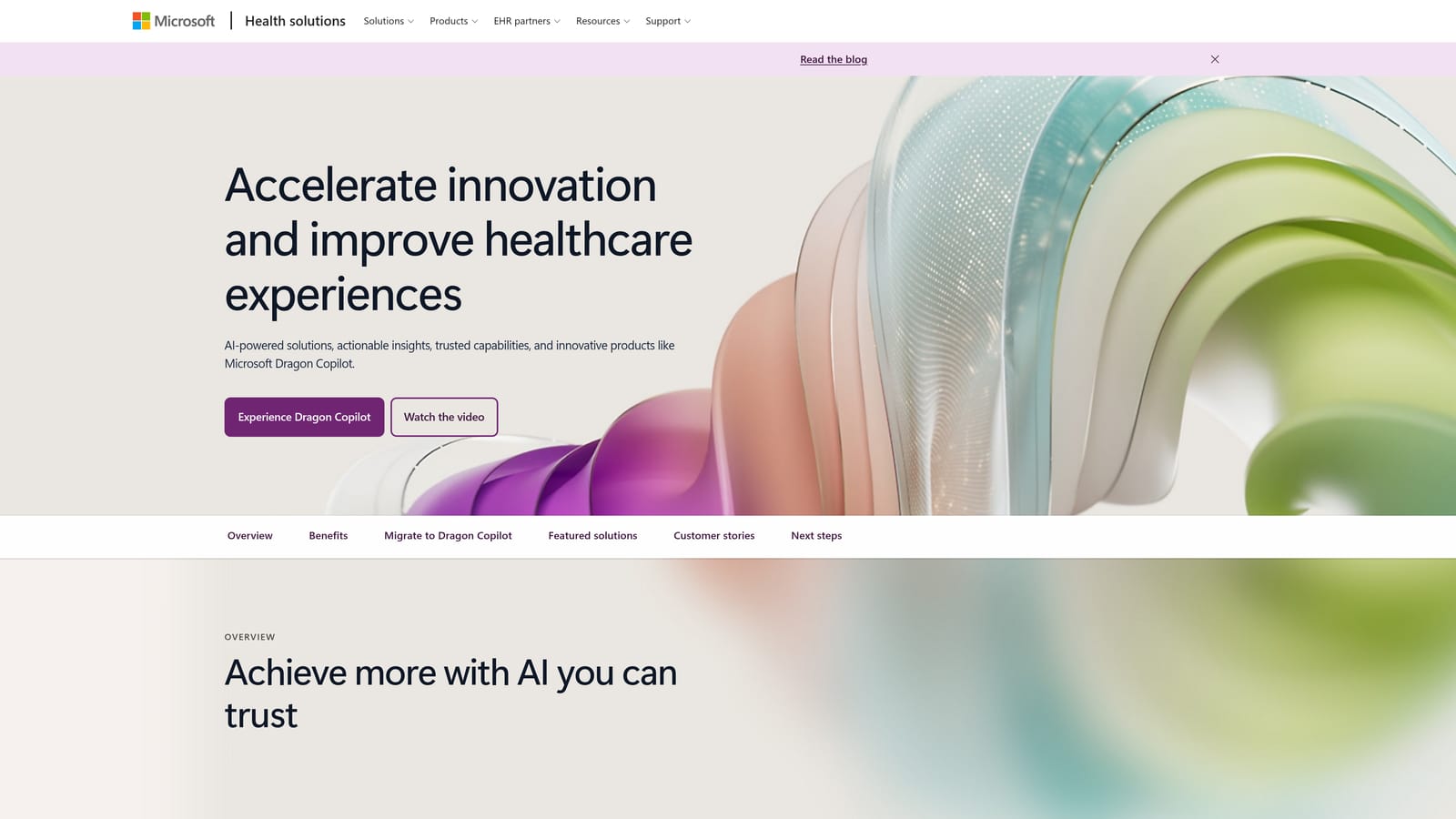
Screenshot of Nuance DAX Copilot website

Where This Tool Shines

DAX Copilot's defining advantage is its ambient listening model. Physicians do not need to pause, activate a dictation mode, or narrate their thought process. The AI captures the full encounter conversation and produces a structured note afterward. For high-volume outpatient settings where interrupting the patient interaction to dictate would feel disruptive, this is a meaningful workflow improvement.

The tool also benefits from Microsoft's deep integration with Epic and its broader healthcare AI ecosystem, which makes it a natural choice for enterprise health systems already invested in that technology stack.

Key Features

Ambient Listening: No active dictation required; the AI captures the encounter conversation and generates notes automatically.

Deep Epic Integration: Designed with strong Epic compatibility and broad support for other major EHR platforms.

Specialty-Appropriate Note Structures: Generates notes formatted for the relevant clinical specialty and encounter type.

Microsoft Healthcare Ecosystem: Connects with Microsoft's broader suite of healthcare AI tools and cloud infrastructure.

Enterprise Scalability: Built for high-volume deployment across large health systems and outpatient networks.

Best For

Nuance DAX Copilot is best suited for enterprise health systems and large outpatient practices, particularly those running Epic, where ambient documentation at scale is the primary goal.

Pricing

Custom enterprise pricing. Contact Nuance or Microsoft directly for a quote based on your organization's size and deployment needs.

3. Suki AI

Best for: Physicians who want a conversational voice assistant for note creation and EHR navigation with minimal IT setup.

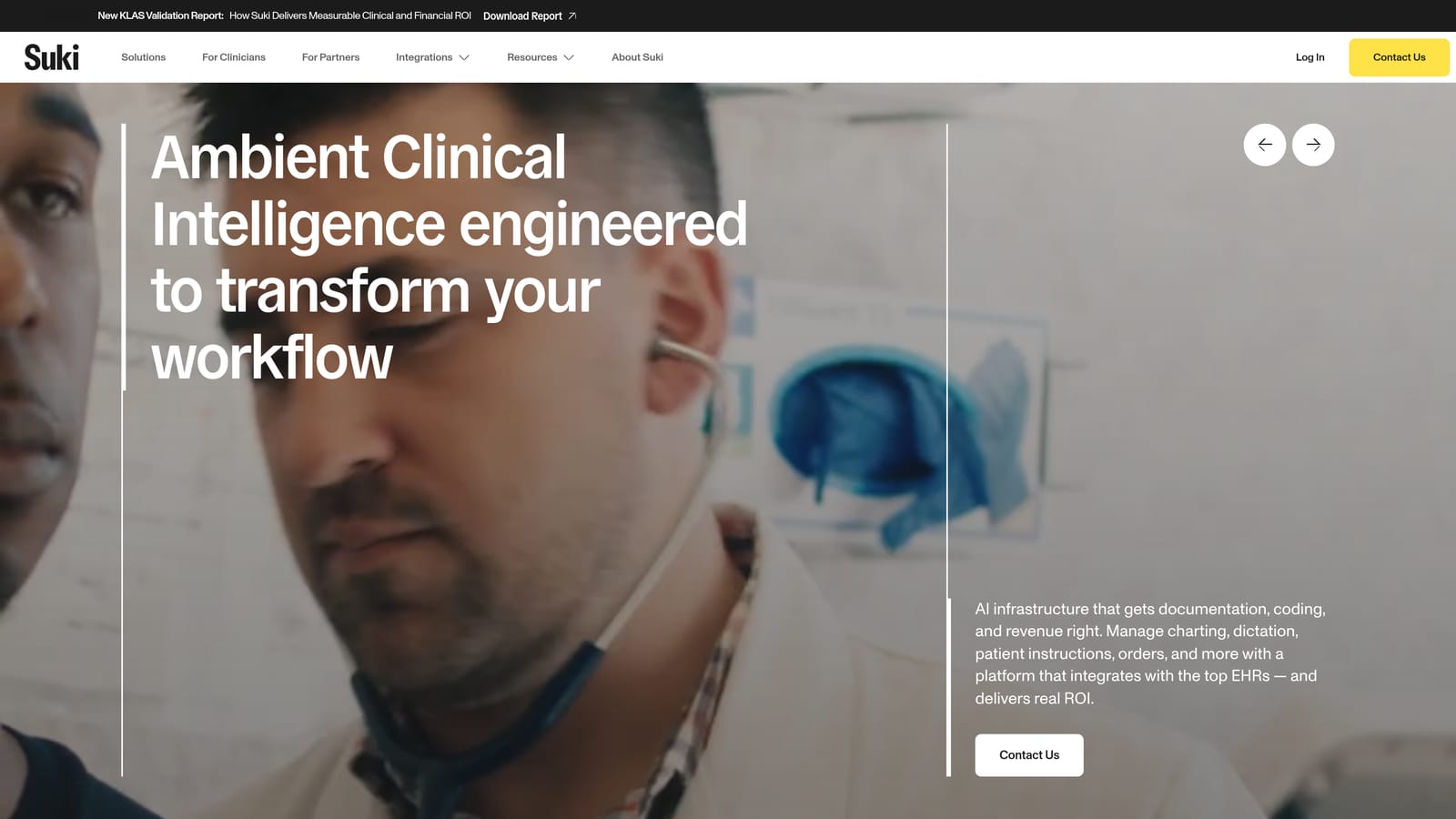
Suki AI is a voice-first AI assistant that lets physicians dictate notes, add diagnoses, and issue EHR commands using natural conversational speech, functioning as an intelligent layer on top of existing clinical workflows.

Screenshot of Suki AI website

Where This Tool Shines

Suki differentiates itself by going beyond simple transcription. Physicians can use natural voice commands to navigate EHR functions, pull up patient records, and add diagnoses without touching a keyboard. That conversational interface reduces the cognitive overhead of documentation and makes the tool feel more like a capable assistant than a transcription engine.

Setup is also notably fast and lightweight compared to enterprise-tier solutions, making it accessible to practices that do not have dedicated IT teams to manage complex deployments.

Key Features

Conversational Voice Interface: Supports natural speech commands for note creation, diagnosis entry, and EHR navigation.

Real-Time Note Drafting: Drafts notes as the physician speaks, reducing post-visit documentation time.

Broad EHR Compatibility: Integrates with Epic, Athena, Cerner, and other major platforms.

Fast Deployment: Minimal IT overhead and quick setup, suitable for practices without large technical teams.

Multi-Specialty Support: Designed to support a range of clinical specialties and note types.

Best For

Suki AI works well for independent physicians and small-to-mid-size practices that want a smart voice assistant with EHR navigation capabilities, particularly those prioritizing quick deployment without heavy IT involvement.

Pricing

Custom pricing. Contact Suki directly for details on plans and per-provider rates.

4. Augmedix

Best for: Health systems and large group practices that want flexibility between live remote scribing and automated AI documentation.

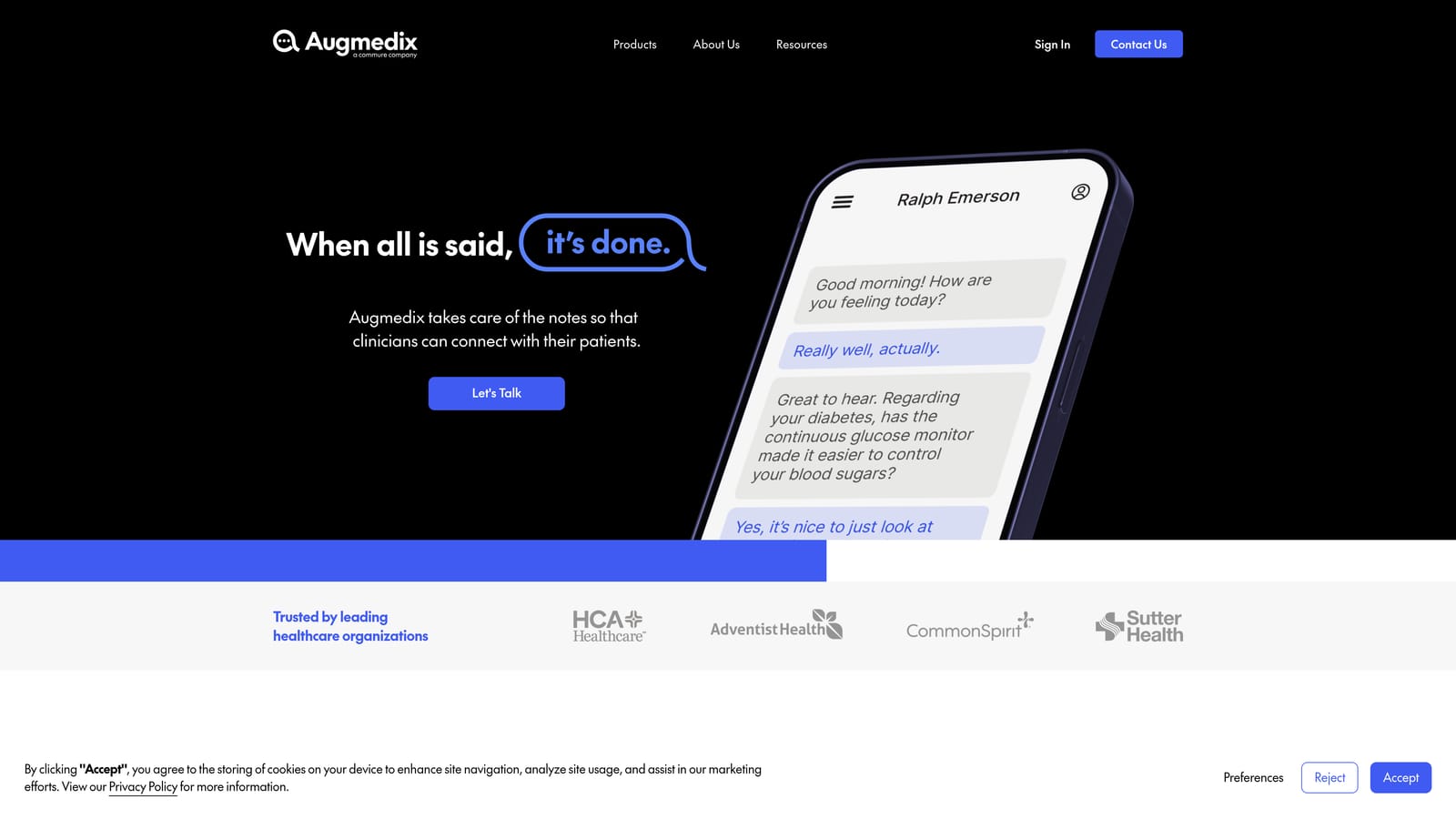
Augmedix is a hybrid documentation platform offering both live remote medical scribing and automated AI note generation, giving practices meaningful flexibility in how they handle clinical documentation across different encounter types and complexity levels.

Screenshot of Augmedix website

Where This Tool Shines

Augmedix's two-tier model is its clearest differentiator. Practices can use live remote scribes for high-acuity or complex encounters where a human in the loop adds real value, then switch to the automated Augmedix Go tier for higher-volume, lower-complexity visits. That flexibility is genuinely useful for health systems managing diverse patient populations and encounter types under one documentation platform.

The live scribing model also provides a level of real-time documentation quality that purely AI-driven tools cannot replicate, particularly for complex specialty cases where clinical nuance matters most.

Key Features

Dual-Tier Model: Offers both live remote scribing and Augmedix Go automated AI notes, allowing practices to match documentation approach to encounter complexity.

Real-Time Documentation: Notes are generated during the patient encounter, reducing post-visit charting time significantly.

Major EHR Integration: Connects with leading EHR platforms used across health systems and large group practices.

High-Acuity Specialty Support: Designed to handle complex specialty documentation where accuracy and detail are critical.

Enterprise Scale: Built for health systems and large practices managing high documentation volumes.

Best For

Augmedix is well-suited for health systems and large group practices that want the option to deploy live scribing for complex encounters while using automated AI documentation for routine visits.

Pricing

Custom pricing based on tier selection, volume, and practice size. Contact Augmedix for a tailored quote.

5. DeepScribe

Best for: Specialty practices dealing with complex clinical language that benefit from specialty-tuned AI models and structured note output.

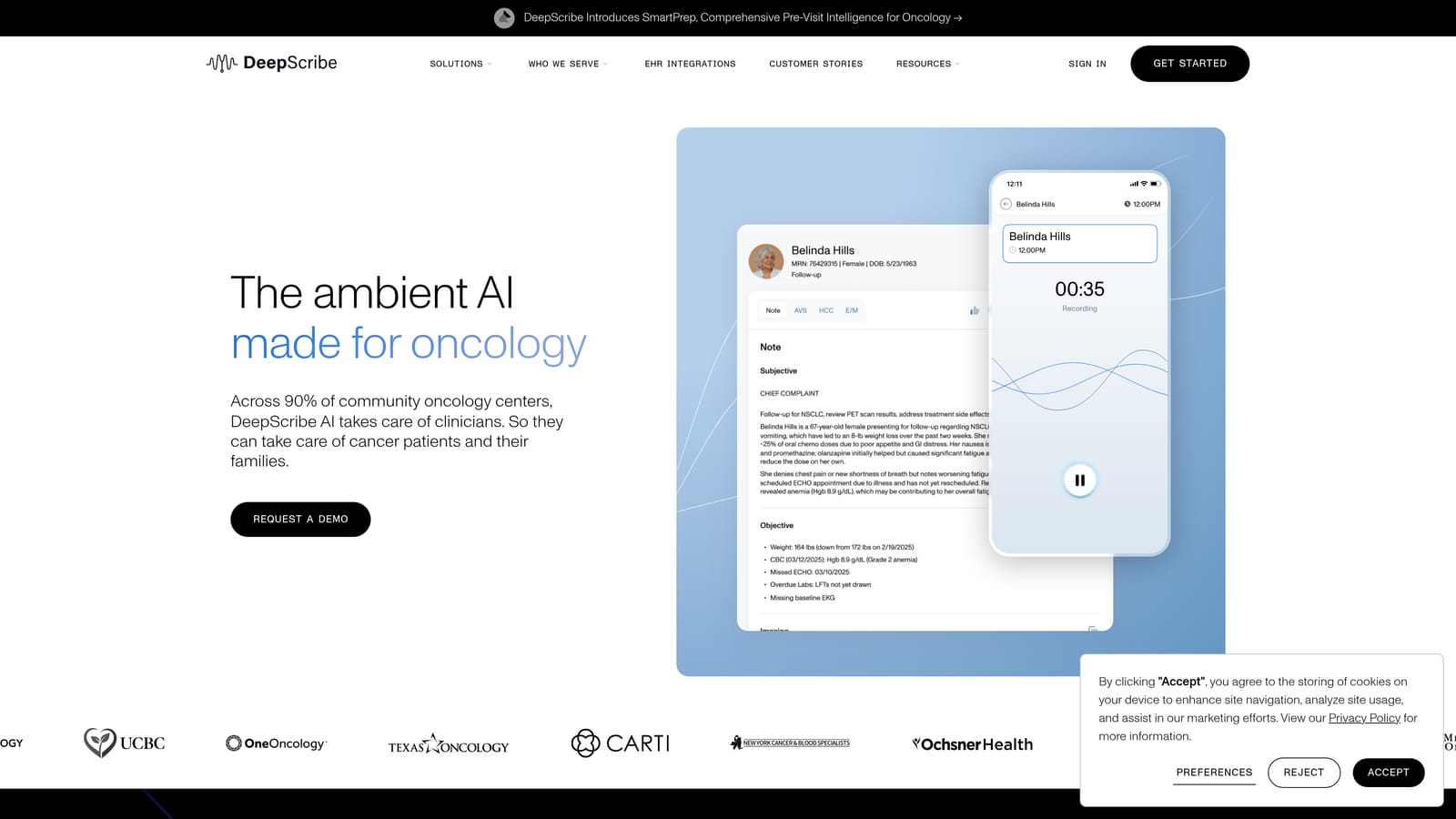
DeepScribe is an ambient AI documentation platform with specialty-specific language models, designed to capture complex clinical conversations and produce structured, accurate notes without requiring active dictation.

Screenshot of DeepScribe website

Where This Tool Shines

DeepScribe's investment in specialty-tuned AI models gives it an edge in environments where clinical language is highly technical and domain-specific. Oncology, cardiology, and other complex specialties generate conversations that generic AI models can struggle to interpret accurately. DeepScribe's models are trained on specialty clinical language, which can meaningfully improve note quality in those settings.

The post-visit review interface also gives physicians a clean, efficient way to review and finalize notes before they are committed to the EHR, keeping the physician in control of the final output without adding significant time to the documentation process.

Key Features

Specialty-Specific AI Models: Language models trained on clinical specialty vocabulary for improved accuracy in complex documentation contexts.

Ambient Listening: No active dictation required; the AI captures and structures encounter conversations automatically.

EHR-Mapped Note Output: Structured notes are mapped to EHR templates for clean, compliant documentation delivery.

Complex Specialty Support: Specifically designed for oncology, cardiology, and other high-complexity specialties.

Post-Visit Review Interface: Physicians can review and edit AI-generated notes efficiently before finalizing.

Best For

DeepScribe is a strong choice for specialty practices, particularly in oncology, cardiology, and similar high-complexity fields, where specialty-tuned AI accuracy and structured note output are priorities.

Pricing

Custom pricing. Contact DeepScribe directly for specialty-specific pricing details.

6. Nuance Dragon Medical One

Best for: Enterprise and hospital settings that need a highly customizable, cloud-based speech recognition engine that works across EHR platforms and clinical applications.

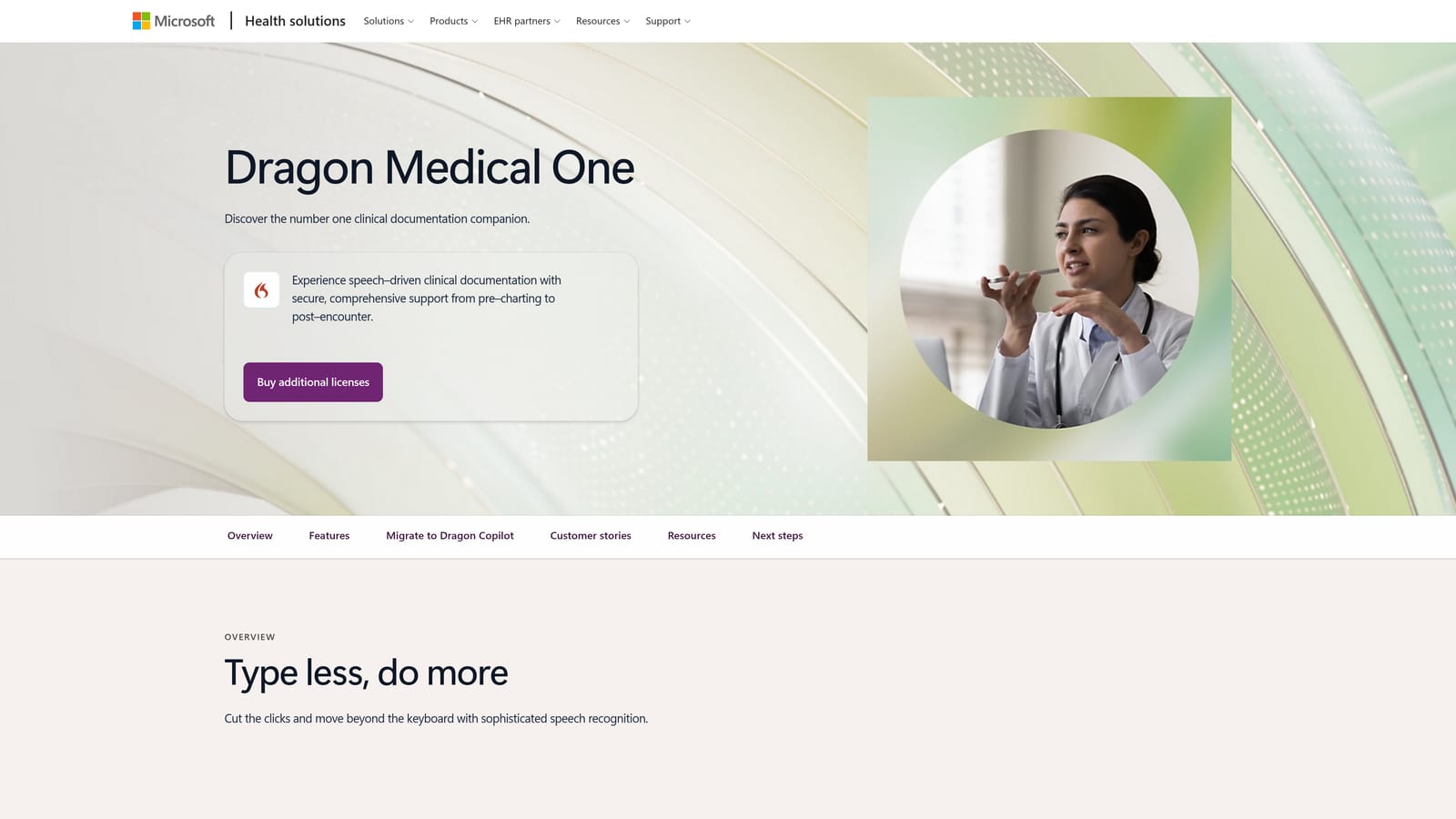
Nuance Dragon Medical One is the industry-standard cloud-based speech recognition platform, enabling physicians to dictate directly into EHR fields using a large, customizable medical vocabulary.

Screenshot of Nuance Dragon Medical One website

Where This Tool Shines

Dragon Medical One is the foundational speech recognition engine that many other healthcare AI tools are built upon, which speaks to its maturity and reliability. It adapts to individual physician speech patterns over time, improving recognition accuracy the more it is used. For physicians who prefer active dictation control over ambient AI, it offers a familiar and highly refined experience.

Its enterprise-grade deployment and management tools make it practical for IT teams managing large physician populations across multiple facilities and EHR environments.

Key Features

Cloud-Based Speech Recognition: Large, specialized medical vocabulary with cloud delivery for consistent performance across devices and locations.

Individual Adaptation: Learns and adapts to each physician's speech patterns, accent, and terminology over time.

Cross-Platform Compatibility: Works across EHR platforms and clinical applications in enterprise environments.

Enterprise Management Tools: Robust deployment, administration, and management capabilities for large-scale rollouts.

Foundational Engine: Serves as the underlying speech engine for many downstream healthcare AI and documentation tools.

Best For

Dragon Medical One is best suited for hospitals, health systems, and enterprise practices that want a proven, highly customizable speech recognition engine and prefer active dictation over ambient AI capture.

Pricing

Custom enterprise pricing. Contact Nuance directly for deployment-specific pricing based on your organization's size and needs.

7. Abridge

Best for: Practices and health systems that want to improve both physician documentation efficiency and patient communication from a single encounter recording.

Abridge is an AI documentation tool that records and transcribes patient encounters, then generates both structured clinical notes and plain-language patient summaries from the same conversation.

Where This Tool Shines

Abridge's dual-output model is genuinely distinctive. Most documentation tools focus exclusively on the physician-facing note. Abridge generates that note and simultaneously produces a patient-facing summary in accessible language, addressing two documentation challenges in a single workflow step. That combination has particular value in settings where patient engagement and health literacy are organizational priorities.

The tool is trained on real clinical conversations, which supports natural-sounding output across a range of encounter types and specialties, and its Epic integration makes deployment straightforward in health systems already running that platform.

Key Features

Dual-Output Documentation: Generates structured clinical notes and plain-language patient summaries simultaneously from one encounter recording.

Clinically Trained AI: AI models trained on real clinical conversations for natural, accurate note generation.

Epic and Major EHR Integration: Designed for compatibility with Epic and other leading EHR platforms.

Specialty and Primary Care Support: Supports a range of clinical settings from primary care to specialty practices.

Patient Engagement Focus: Addresses the patient communication side of documentation alongside physician efficiency.

Best For

Abridge is an excellent fit for health systems and practices where patient engagement and communication are as important as documentation efficiency, and for organizations looking to address both in a single integrated tool.

Pricing

Custom pricing. Contact Abridge directly for details on health system and practice-level pricing.

8. Nabla Copilot

Best for: Independent physicians and small practices seeking an accessible, lightweight ambient documentation tool with a low barrier to entry.

Nabla Copilot is a browser-based ambient AI documentation tool designed for fast deployment and accessibility, making it particularly well-suited to independent physicians and smaller practices that need effective documentation support without complex IT infrastructure.

Where This Tool Shines

Nabla Copilot removes many of the traditional barriers to adopting ambient AI documentation. Because it runs in the browser, there is no hardware to install, no lengthy IT implementation, and no steep learning curve. A physician can begin using it quickly, which is a meaningful advantage for independent practices that do not have dedicated IT support.

It also supports both in-person and telehealth encounters, making it flexible enough to handle the mixed-modality reality of modern outpatient practice without requiring separate tools for each setting.

Key Features

Browser-Based Access: Runs entirely in the browser with no hardware requirements or complex IT setup needed.

Ambient AI Documentation: Listens to encounters and generates structured notes automatically without active dictation.

Multiple Note Formats: Supports a range of note formats and clinical specialties for flexible documentation output.

Telehealth Compatible: Works for both in-person and virtual patient encounters.

Accessible Pricing: Offers a free tier alongside paid plans, making it one of the more cost-accessible options in the category.

Best For

Nabla Copilot is best for independent physicians, small practices, and telehealth providers who want ambient AI documentation with minimal setup, low cost, and no IT dependency.

Pricing

A free tier is available. Paid plans vary; visit Nabla's website for current pricing details, as these are updated periodically.

9. Iodine Software (Artifact)

Best for: Hospital medicine, inpatient settings, and health information management teams focused on clinical documentation improvement and coding accuracy.

Iodine Software, through its Artifact platform, is an AI-driven clinical documentation improvement solution for hospitals and health systems, designed to bridge the gap between clinical note quality and accurate medical coding.

Where This Tool Shines

Iodine Software approaches the documentation problem from a different angle than most tools on this list. Rather than focusing on transcription speed or ambient listening, it focuses on documentation completeness and coding accuracy. The platform identifies gaps in clinical notes that could affect diagnosis coding, reimbursement accuracy, and compliance, making it especially valuable for CDI specialist teams and health information management departments.

For hospitals where documentation quality directly impacts revenue integrity and regulatory compliance, Iodine provides a layer of AI-assisted intelligence that complements the note-generation tools physicians use at the point of care.

Key Features

AI-Assisted CDI Workflows: Supports clinical documentation improvement specialists in identifying and addressing documentation gaps systematically.

Coding Accuracy Focus: Identifies documentation issues that affect diagnosis coding accuracy and downstream reimbursement.

Inpatient and Hospital Medicine Design: Built specifically for inpatient settings and the complex documentation demands of hospital medicine.

EHR and Coding System Integration: Connects with hospital EHR platforms and medical coding workflows.

HIM and CDI Team Support: Designed to augment the work of health information management and CDI specialist teams, not just frontline physicians.

Best For

Iodine Software is the right choice for hospital systems, inpatient medicine programs, and health information management teams that need AI-powered CDI support to improve documentation quality, coding accuracy, and revenue integrity.

Pricing

Custom enterprise pricing. Contact Iodine Software directly for a quote based on facility size and deployment scope.

Which Tool Is Right for Your Practice?

The nine tools covered here represent the breadth of what voice to text medical software looks like in 2026, from traditional active dictation platforms to fully ambient AI and specialized CDI solutions. Choosing the right one comes down to a few key factors: your specialty, your documentation volume, your EHR environment, and whether you need AI alone or AI paired with human verification.

Here is a quick-reference guide by care setting and use case to help you narrow it down.

Solo practitioners and small practices: Nabla Copilot offers the lowest barrier to entry with browser-based access and a free tier. Suki AI is a strong step up for those who want conversational EHR navigation alongside transcription. ZyDoc is the right call when accuracy and human review matter more than cost minimization.

Specialty groups: ZyDoc's support for more than 20 specialties with human editor review makes it a reliable choice across complex documentation environments. DeepScribe is worth evaluating for oncology, cardiology, and other fields where specialty-tuned AI models can meaningfully improve note quality.

Hospitals and health systems: Nuance DAX Copilot and Dragon Medical One are the enterprise-tier standards, with DAX Copilot best for ambient documentation at scale and Dragon Medical One for active dictation with maximum customization. Augmedix adds flexibility with its hybrid scribing model. Iodine Software (Artifact) is the clear choice when CDI and coding accuracy are the primary concern rather than point-of-care transcription.

Ambulatory surgery centers and high-volume outpatient settings: ZyDoc's no-workflow-change model and universal EHR compatibility make it practical for ASCs that need reliable, high-accuracy documentation without disrupting existing processes. Nuance DAX Copilot is also well-suited for high-volume outpatient environments.

Telehealth and hybrid practices: Nabla Copilot and Abridge both support virtual encounters natively. Abridge adds the patient summary output, which is particularly useful when clear post-visit communication is a care quality priority.

No single tool is the universal answer. The best voice to text medical software for your practice is the one that fits your specialty, your EHR, your volume, and your tolerance for AI-only versus AI-plus-human workflows. If that last point matters to you, ZyDoc's combination of AI speed and human editor review is worth a close look.

Clear your backlog. Sign finished notes, reports, and encounter summaries today. From your schedule feed, direct to the EHR with real humans in the loop. Start your 7-day trial today or contact us to set up a demo for your team and receive 30 days of our full STAT service on us!

Heading 1

Heading 2

Heading 3

Heading 4

Heading 5
Heading 6

Lorem ipsum dolor sit amet, consectetur adipiscing elit, sed do eiusmod tempor incididunt ut labore et dolore magna aliqua. Ut enim ad minim veniam, quis nostrud exercitation ullamco laboris nisi ut aliquip ex ea commodo consequat. Duis aute irure dolor in reprehenderit in voluptate velit esse cillum dolore eu fugiat nulla pariatur.

Block quote

Ordered list

  1. Item 1
  2. Item 2
  3. Item 3

Unordered list

  • Item A
  • Item B
  • Item C

Text link

Bold text

Emphasis

Superscript

Subscript

Heading 1

Heading 2

Heading 3

Heading 4

Heading 5
Heading 6

Lorem ipsum dolor sit amet, consectetur adipiscing elit, sed do eiusmod tempor incididunt ut labore et dolore magna aliqua. Ut enim ad minim veniam, quis nostrud exercitation ullamco laboris nisi ut aliquip ex ea commodo consequat. Duis aute irure dolor in reprehenderit in voluptate velit esse cillum dolore eu fugiat nulla pariatur.

Block quote

Ordered list

  1. Item 1
  2. Item 2
  3. Item 3

Unordered list

  • Item A
  • Item B
  • Item C

Text link

Bold text

Emphasis

Superscript

Subscript

Trusted and Tested

Why Doctors Choose ZyDoc Medical Transcription.

Hospitals

ZyDoc has offered a productive solution that allows our Patient Care Providers to maintain prompt patient care, efficient patient documentation turnaround, and a preferred convenience with the use of smart phone app for dictation. With the integrated interface into our EMR, completed patient visit notes are available promptly for continued patient care and sharing of information. Additionally, the response time for support and application assistance is excellent, knowledgeable and friendly.

Michelle MacDonald
Copley Hospital
Orthopedic

"The doctors like the mobile app and they find it easy to use!"

Sandy Wagner
Arlington Orthopedics
Orthopedic

"Professional service, fast turnaround, very efficient and excellent value for money!"

Milan Oleksak, M.D.
Orthopaedic & Physiotherapy Associates
Orthopedic

“I have never dealt with an easier transcription service. Rapid turnaround time for dictations and an easy to contact customer service.”

Jennifer Biddle
Advanced Physician Services, PC
ASCs

“It has been really easy to get ZyDoc up and running at our new multi-specialty center. The team at Zydoc has been top quality and easy to work with and the physicians are finding the service very easy to use.

Amy Cooper - CEO
Green Mountain Surgery Center
Mental Health

“Accuracy: The level of accuracy is exceptional and exceeds the expected accuracy standards! Customer service: Consistently amazing customer service. Never too busy and always makes you feel important. Communication: Working with ZyDoc to integrate our myAvatar EHR system and the committed communication is the key to our success. Thank you for all you do for us and thanks for always caring!”

Nevada Department of Health and Human Services
Division of Child and Family Services

Stop Wasting Time in Your EHR.

Say it once. Get it done.

With ZyDoc’s mobile-friendly documentation, you can skip the endless typing and clicking. Just select your patient, choose the note type, and dictate. We’ll handle the rest with flawless EHR insertion.

Comparison

9 Best Voice to Text Medical Software Tools in 2026

Physicians routinely spend a substantial portion of their workday on documentation rather than direct patient care. That imbalance is exactly what voice to text medical software is designed to fix, giving clinicians the freedom to speak naturally while software handles transcription, formatting, and EHR entry.

But the category has grown considerably, and not every solution works the same way. Some tools rely entirely on AI. Others combine AI with human review. Some listen passively during encounters; others require active dictation. And a handful are purpose-built for specific care settings or specialties.

This guide covers the top voice to text medical software tools available in 2026, evaluated on accuracy, EHR integration, specialty support, workflow fit, and overall value. Whether you run a solo practice, lead a specialty group, manage a hospital system, or operate an ambulatory surgery center, there is a solution here worth your attention. ZyDoc appears first because it is the platform behind this content, but every tool on this list has been selected for genuine merit.

1. ZyDoc

Best for: Physicians and practices that want AI-powered transcription verified by human medical editors, with seamless EHR integration across all major platforms.

ZyDoc is an AI-powered clinical documentation and transcription platform that pairs speech recognition with human medical editor review, automatically populating finished notes into your EHR without requiring any workflow changes.

Screenshot of ZyDoc website

Where This Tool Shines

ZyDoc occupies a distinct position in the market: it does not ask you to choose between AI speed and human accuracy. Every note generated by the AI engine is reviewed and corrected by a trained medical editor before it lands in your EHR. That layer of human oversight is particularly valuable for complex specialty documentation where nuance matters and errors carry real consequences.

The platform is also genuinely flexible on the input side. Physicians can dictate via smartphone app, traditional handheld recorder, or telephone, fitting naturally into existing habits rather than demanding new ones. That flexibility, combined with support for all major EHR platforms, makes adoption straightforward even in practices with established workflows.

Key Features

AI Plus Human Review: Every transcription is reviewed and corrected by a human medical editor before delivery, combining speed with an additional layer of quality assurance.

Universal EHR Integration: Automatically populates notes into Epic, Cerner, Athena, and all other major EHR platforms without custom configuration per site.

Flexible Dictation Input: Physicians can dictate via phone, mobile app, or handheld recorder, with no requirement to change how they currently work.

Specialty Breadth: Supports more than 20 specialties, including surgery, cardiology, orthopedics, mental health, and more, with documentation formatted appropriately for each.

HIPAA-Compliant Security: Enterprise-grade security and compliance protocols protect patient data throughout the transcription and delivery process.

Best For

ZyDoc is an excellent fit for solo practitioners, specialty groups, hospitals, and ambulatory surgery centers that prioritize accuracy and want the assurance of human review. It is especially well-suited to high-complexity specialties where documentation errors can affect care quality, billing, and compliance.

Pricing

Custom pricing based on practice size, specialty, and volume. Contact ZyDoc directly for a quote tailored to your documentation needs.

2. Nuance DAX Copilot

Best for: Large health systems and enterprise outpatient settings seeking fully ambient, hands-free clinical documentation tightly integrated with Epic.

Nuance DAX Copilot is Microsoft's ambient AI clinical documentation tool that passively listens to patient-physician encounters and automatically generates structured clinical notes without requiring any active dictation.

Screenshot of Nuance DAX Copilot website

Where This Tool Shines

DAX Copilot's defining advantage is its ambient listening model. Physicians do not need to pause, activate a dictation mode, or narrate their thought process. The AI captures the full encounter conversation and produces a structured note afterward. For high-volume outpatient settings where interrupting the patient interaction to dictate would feel disruptive, this is a meaningful workflow improvement.

The tool also benefits from Microsoft's deep integration with Epic and its broader healthcare AI ecosystem, which makes it a natural choice for enterprise health systems already invested in that technology stack.

Key Features

Ambient Listening: No active dictation required; the AI captures the encounter conversation and generates notes automatically.

Deep Epic Integration: Designed with strong Epic compatibility and broad support for other major EHR platforms.

Specialty-Appropriate Note Structures: Generates notes formatted for the relevant clinical specialty and encounter type.

Microsoft Healthcare Ecosystem: Connects with Microsoft's broader suite of healthcare AI tools and cloud infrastructure.

Enterprise Scalability: Built for high-volume deployment across large health systems and outpatient networks.

Best For

Nuance DAX Copilot is best suited for enterprise health systems and large outpatient practices, particularly those running Epic, where ambient documentation at scale is the primary goal.

Pricing

Custom enterprise pricing. Contact Nuance or Microsoft directly for a quote based on your organization's size and deployment needs.

3. Suki AI

Best for: Physicians who want a conversational voice assistant for note creation and EHR navigation with minimal IT setup.

Suki AI is a voice-first AI assistant that lets physicians dictate notes, add diagnoses, and issue EHR commands using natural conversational speech, functioning as an intelligent layer on top of existing clinical workflows.

Screenshot of Suki AI website

Where This Tool Shines

Suki differentiates itself by going beyond simple transcription. Physicians can use natural voice commands to navigate EHR functions, pull up patient records, and add diagnoses without touching a keyboard. That conversational interface reduces the cognitive overhead of documentation and makes the tool feel more like a capable assistant than a transcription engine.

Setup is also notably fast and lightweight compared to enterprise-tier solutions, making it accessible to practices that do not have dedicated IT teams to manage complex deployments.

Key Features

Conversational Voice Interface: Supports natural speech commands for note creation, diagnosis entry, and EHR navigation.

Real-Time Note Drafting: Drafts notes as the physician speaks, reducing post-visit documentation time.

Broad EHR Compatibility: Integrates with Epic, Athena, Cerner, and other major platforms.

Fast Deployment: Minimal IT overhead and quick setup, suitable for practices without large technical teams.

Multi-Specialty Support: Designed to support a range of clinical specialties and note types.

Best For

Suki AI works well for independent physicians and small-to-mid-size practices that want a smart voice assistant with EHR navigation capabilities, particularly those prioritizing quick deployment without heavy IT involvement.

Pricing

Custom pricing. Contact Suki directly for details on plans and per-provider rates.

4. Augmedix

Best for: Health systems and large group practices that want flexibility between live remote scribing and automated AI documentation.

Augmedix is a hybrid documentation platform offering both live remote medical scribing and automated AI note generation, giving practices meaningful flexibility in how they handle clinical documentation across different encounter types and complexity levels.

Screenshot of Augmedix website

Where This Tool Shines

Augmedix's two-tier model is its clearest differentiator. Practices can use live remote scribes for high-acuity or complex encounters where a human in the loop adds real value, then switch to the automated Augmedix Go tier for higher-volume, lower-complexity visits. That flexibility is genuinely useful for health systems managing diverse patient populations and encounter types under one documentation platform.

The live scribing model also provides a level of real-time documentation quality that purely AI-driven tools cannot replicate, particularly for complex specialty cases where clinical nuance matters most.

Key Features

Dual-Tier Model: Offers both live remote scribing and Augmedix Go automated AI notes, allowing practices to match documentation approach to encounter complexity.

Real-Time Documentation: Notes are generated during the patient encounter, reducing post-visit charting time significantly.

Major EHR Integration: Connects with leading EHR platforms used across health systems and large group practices.

High-Acuity Specialty Support: Designed to handle complex specialty documentation where accuracy and detail are critical.

Enterprise Scale: Built for health systems and large practices managing high documentation volumes.

Best For

Augmedix is well-suited for health systems and large group practices that want the option to deploy live scribing for complex encounters while using automated AI documentation for routine visits.

Pricing

Custom pricing based on tier selection, volume, and practice size. Contact Augmedix for a tailored quote.

5. DeepScribe

Best for: Specialty practices dealing with complex clinical language that benefit from specialty-tuned AI models and structured note output.

DeepScribe is an ambient AI documentation platform with specialty-specific language models, designed to capture complex clinical conversations and produce structured, accurate notes without requiring active dictation.

Screenshot of DeepScribe website

Where This Tool Shines

DeepScribe's investment in specialty-tuned AI models gives it an edge in environments where clinical language is highly technical and domain-specific. Oncology, cardiology, and other complex specialties generate conversations that generic AI models can struggle to interpret accurately. DeepScribe's models are trained on specialty clinical language, which can meaningfully improve note quality in those settings.

The post-visit review interface also gives physicians a clean, efficient way to review and finalize notes before they are committed to the EHR, keeping the physician in control of the final output without adding significant time to the documentation process.

Key Features

Specialty-Specific AI Models: Language models trained on clinical specialty vocabulary for improved accuracy in complex documentation contexts.

Ambient Listening: No active dictation required; the AI captures and structures encounter conversations automatically.

EHR-Mapped Note Output: Structured notes are mapped to EHR templates for clean, compliant documentation delivery.

Complex Specialty Support: Specifically designed for oncology, cardiology, and other high-complexity specialties.

Post-Visit Review Interface: Physicians can review and edit AI-generated notes efficiently before finalizing.

Best For

DeepScribe is a strong choice for specialty practices, particularly in oncology, cardiology, and similar high-complexity fields, where specialty-tuned AI accuracy and structured note output are priorities.

Pricing

Custom pricing. Contact DeepScribe directly for specialty-specific pricing details.

6. Nuance Dragon Medical One

Best for: Enterprise and hospital settings that need a highly customizable, cloud-based speech recognition engine that works across EHR platforms and clinical applications.

Nuance Dragon Medical One is the industry-standard cloud-based speech recognition platform, enabling physicians to dictate directly into EHR fields using a large, customizable medical vocabulary.

Screenshot of Nuance Dragon Medical One website

Where This Tool Shines

Dragon Medical One is the foundational speech recognition engine that many other healthcare AI tools are built upon, which speaks to its maturity and reliability. It adapts to individual physician speech patterns over time, improving recognition accuracy the more it is used. For physicians who prefer active dictation control over ambient AI, it offers a familiar and highly refined experience.

Its enterprise-grade deployment and management tools make it practical for IT teams managing large physician populations across multiple facilities and EHR environments.

Key Features

Cloud-Based Speech Recognition: Large, specialized medical vocabulary with cloud delivery for consistent performance across devices and locations.

Individual Adaptation: Learns and adapts to each physician's speech patterns, accent, and terminology over time.

Cross-Platform Compatibility: Works across EHR platforms and clinical applications in enterprise environments.

Enterprise Management Tools: Robust deployment, administration, and management capabilities for large-scale rollouts.

Foundational Engine: Serves as the underlying speech engine for many downstream healthcare AI and documentation tools.

Best For

Dragon Medical One is best suited for hospitals, health systems, and enterprise practices that want a proven, highly customizable speech recognition engine and prefer active dictation over ambient AI capture.

Pricing

Custom enterprise pricing. Contact Nuance directly for deployment-specific pricing based on your organization's size and needs.

7. Abridge

Best for: Practices and health systems that want to improve both physician documentation efficiency and patient communication from a single encounter recording.

Abridge is an AI documentation tool that records and transcribes patient encounters, then generates both structured clinical notes and plain-language patient summaries from the same conversation.

Where This Tool Shines

Abridge's dual-output model is genuinely distinctive. Most documentation tools focus exclusively on the physician-facing note. Abridge generates that note and simultaneously produces a patient-facing summary in accessible language, addressing two documentation challenges in a single workflow step. That combination has particular value in settings where patient engagement and health literacy are organizational priorities.

The tool is trained on real clinical conversations, which supports natural-sounding output across a range of encounter types and specialties, and its Epic integration makes deployment straightforward in health systems already running that platform.

Key Features

Dual-Output Documentation: Generates structured clinical notes and plain-language patient summaries simultaneously from one encounter recording.

Clinically Trained AI: AI models trained on real clinical conversations for natural, accurate note generation.

Epic and Major EHR Integration: Designed for compatibility with Epic and other leading EHR platforms.

Specialty and Primary Care Support: Supports a range of clinical settings from primary care to specialty practices.

Patient Engagement Focus: Addresses the patient communication side of documentation alongside physician efficiency.

Best For

Abridge is an excellent fit for health systems and practices where patient engagement and communication are as important as documentation efficiency, and for organizations looking to address both in a single integrated tool.

Pricing

Custom pricing. Contact Abridge directly for details on health system and practice-level pricing.

8. Nabla Copilot

Best for: Independent physicians and small practices seeking an accessible, lightweight ambient documentation tool with a low barrier to entry.

Nabla Copilot is a browser-based ambient AI documentation tool designed for fast deployment and accessibility, making it particularly well-suited to independent physicians and smaller practices that need effective documentation support without complex IT infrastructure.

Where This Tool Shines

Nabla Copilot removes many of the traditional barriers to adopting ambient AI documentation. Because it runs in the browser, there is no hardware to install, no lengthy IT implementation, and no steep learning curve. A physician can begin using it quickly, which is a meaningful advantage for independent practices that do not have dedicated IT support.

It also supports both in-person and telehealth encounters, making it flexible enough to handle the mixed-modality reality of modern outpatient practice without requiring separate tools for each setting.

Key Features

Browser-Based Access: Runs entirely in the browser with no hardware requirements or complex IT setup needed.

Ambient AI Documentation: Listens to encounters and generates structured notes automatically without active dictation.

Multiple Note Formats: Supports a range of note formats and clinical specialties for flexible documentation output.

Telehealth Compatible: Works for both in-person and virtual patient encounters.

Accessible Pricing: Offers a free tier alongside paid plans, making it one of the more cost-accessible options in the category.

Best For

Nabla Copilot is best for independent physicians, small practices, and telehealth providers who want ambient AI documentation with minimal setup, low cost, and no IT dependency.

Pricing

A free tier is available. Paid plans vary; visit Nabla's website for current pricing details, as these are updated periodically.

9. Iodine Software (Artifact)

Best for: Hospital medicine, inpatient settings, and health information management teams focused on clinical documentation improvement and coding accuracy.

Iodine Software, through its Artifact platform, is an AI-driven clinical documentation improvement solution for hospitals and health systems, designed to bridge the gap between clinical note quality and accurate medical coding.

Where This Tool Shines

Iodine Software approaches the documentation problem from a different angle than most tools on this list. Rather than focusing on transcription speed or ambient listening, it focuses on documentation completeness and coding accuracy. The platform identifies gaps in clinical notes that could affect diagnosis coding, reimbursement accuracy, and compliance, making it especially valuable for CDI specialist teams and health information management departments.

For hospitals where documentation quality directly impacts revenue integrity and regulatory compliance, Iodine provides a layer of AI-assisted intelligence that complements the note-generation tools physicians use at the point of care.

Key Features

AI-Assisted CDI Workflows: Supports clinical documentation improvement specialists in identifying and addressing documentation gaps systematically.

Coding Accuracy Focus: Identifies documentation issues that affect diagnosis coding accuracy and downstream reimbursement.

Inpatient and Hospital Medicine Design: Built specifically for inpatient settings and the complex documentation demands of hospital medicine.

EHR and Coding System Integration: Connects with hospital EHR platforms and medical coding workflows.

HIM and CDI Team Support: Designed to augment the work of health information management and CDI specialist teams, not just frontline physicians.

Best For

Iodine Software is the right choice for hospital systems, inpatient medicine programs, and health information management teams that need AI-powered CDI support to improve documentation quality, coding accuracy, and revenue integrity.

Pricing

Custom enterprise pricing. Contact Iodine Software directly for a quote based on facility size and deployment scope.

Which Tool Is Right for Your Practice?

The nine tools covered here represent the breadth of what voice to text medical software looks like in 2026, from traditional active dictation platforms to fully ambient AI and specialized CDI solutions. Choosing the right one comes down to a few key factors: your specialty, your documentation volume, your EHR environment, and whether you need AI alone or AI paired with human verification.

Here is a quick-reference guide by care setting and use case to help you narrow it down.

Solo practitioners and small practices: Nabla Copilot offers the lowest barrier to entry with browser-based access and a free tier. Suki AI is a strong step up for those who want conversational EHR navigation alongside transcription. ZyDoc is the right call when accuracy and human review matter more than cost minimization.

Specialty groups: ZyDoc's support for more than 20 specialties with human editor review makes it a reliable choice across complex documentation environments. DeepScribe is worth evaluating for oncology, cardiology, and other fields where specialty-tuned AI models can meaningfully improve note quality.

Hospitals and health systems: Nuance DAX Copilot and Dragon Medical One are the enterprise-tier standards, with DAX Copilot best for ambient documentation at scale and Dragon Medical One for active dictation with maximum customization. Augmedix adds flexibility with its hybrid scribing model. Iodine Software (Artifact) is the clear choice when CDI and coding accuracy are the primary concern rather than point-of-care transcription.

Ambulatory surgery centers and high-volume outpatient settings: ZyDoc's no-workflow-change model and universal EHR compatibility make it practical for ASCs that need reliable, high-accuracy documentation without disrupting existing processes. Nuance DAX Copilot is also well-suited for high-volume outpatient environments.

Telehealth and hybrid practices: Nabla Copilot and Abridge both support virtual encounters natively. Abridge adds the patient summary output, which is particularly useful when clear post-visit communication is a care quality priority.

No single tool is the universal answer. The best voice to text medical software for your practice is the one that fits your specialty, your EHR, your volume, and your tolerance for AI-only versus AI-plus-human workflows. If that last point matters to you, ZyDoc's combination of AI speed and human editor review is worth a close look.

Clear your backlog. Sign finished notes, reports, and encounter summaries today. From your schedule feed, direct to the EHR with real humans in the loop. Start your 7-day trial today or contact us to set up a demo for your team and receive 30 days of our full STAT service on us!
Frequently Asked Questions

Does ZyDoc require workflow changes?

ZyDoc requires no workflow changes for clinicians that are used to dictating.  with telephones just like the hospital systems or digital recorders with 1 click or drag-and-drop upload.  Or smart phone, tablet or browser. on your computer with the microphone make the process easier from your schedule feed to select the patient so you do not have to dictate or keypad demographic patient information.  The finished, expert-reviewed note is inserted directly into the correct EHR sections — no copy-and-paste, no software installation, and minimal training ("minutes to train, not weeks"). The result is the same charting workflow clinicians know, just faster and without the typing-and-clicking burden.

Does ZyDoc support specialty workflows?

Yes. ZyDoc uses proprietary, specialty-specific language models and supports physicians across roughly 20 disciplines, including Anesthesiology, Cardiology, Chiropractic, Dermatology, Endocrinology, Family Practice, Gastroenterology, General Medicine, General Surgery, Genetics, Gynecology, Hematology-Oncology, Independent Medical Examiners, Internal Medicine, Mental Health, Nephrology, Neurology, Ophthalmology, Orthopedics, Radiology and Urology. Each specialty is supported across its major procedures and note types (e.g., op reports, consults, follow-ups, IME reports with e-signature, SOAP notes), and customers can configure job-type templates, default normals, and frequently-used phrase insertions to match how their specialty documents. We integrate with the leaading EHRs of these specialists.

Ready to see ZyDoc in action?

Pricing Plans

Plans from $125/mo.
$0 for 30 days after booking a Demo.

ROI Calculator

See the real financial impact of switching to ZyDoc and estimate how much more revenue you could generate.

Book a Live Demo

Get a personalized walkthrough of how ZyDoc can improve documentation, efficiency, and revenue.

About ZyDoc Clinical IntelligenceTM

Since 1993, ZyDoc has worked alongside physicians, healthcare organizations, researchers, and technology innovators to solve some of healthcare's most complex operational and clinical challenges. Through decades of collaboration with academic institutions, provider organizations, and industryleaders, we've learned that meaningful innovation begins by listening to the people delivering care.

We publish evidence-based research, expert analysis, implementation guidance, and thought leadership designed to help clinicians, executives, administrators, and healthcare innovators make better decisions.

Our commitment to digital health innovation: translate complexity into clarity, ground every insight in evidence, and ensure that the clinical voice remains central to healthcare innovation with the intelligence of business.